
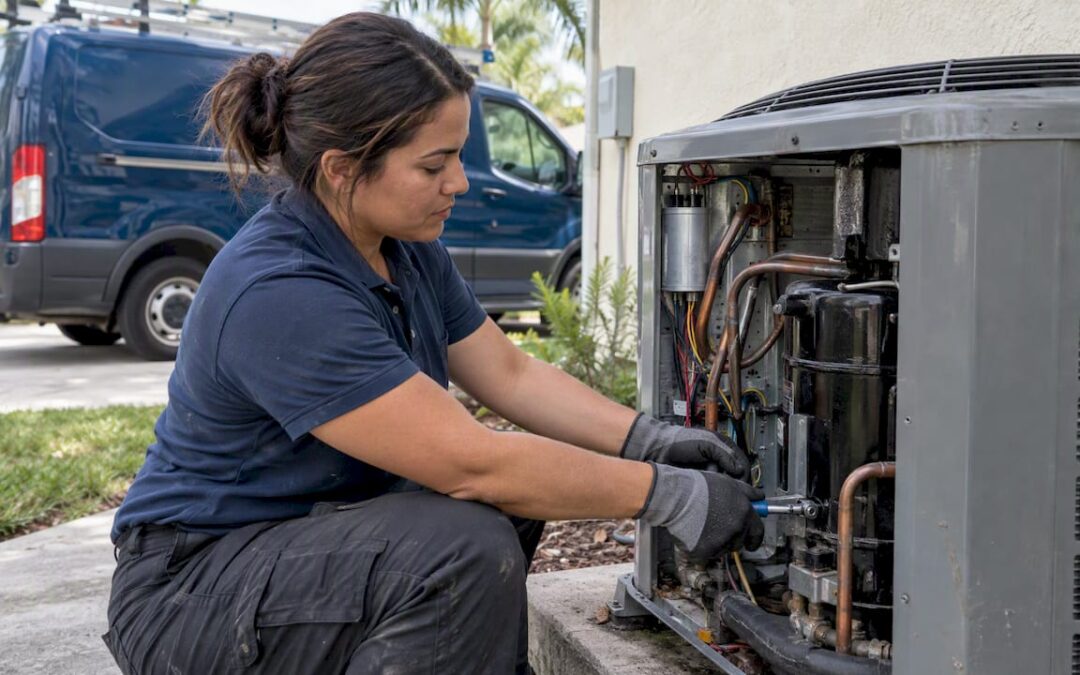
Replacing a central AC compressor typically costs about $1,550 for the part and professional installation, though your price depends on system size, compressor type, refrigerant, labor and how easy the outdoor unit is to reach. It is not a DIY job. It involves refrigerant recovery, brazing and a deep vacuum, and in the U.S. it requires an EPA-certified technician. Whether it is worth doing depends on your system’s age, its warranty status and what else is wrong with it.
This guide explains how to confirm the compressor is the problem, what the work involves, what drives the price, and how to decide between a new compressor and a new system.
Key takeaways
- A national average of about $1,550 covers the compressor and installation, but a full central system replacement runs far higher, so the repair-or-replace question matters more than the part price.
- Warm air, odd noises or an outdoor unit that won’t start can point to the compressor, but they also point to cheaper problems. Get a diagnosis before you approve a compressor.
- A proper replacement includes refrigerant recovery, a new filter drier and a deep vacuum. Skipping any of these shortens the new compressor’s life.
- If the system is old or the compressor died from an underlying problem, replacing the whole system is often the better investment.
Table of Contents
- What the compressor does and why its failure is a big deal
- How to tell if the compressor has actually failed
- What a compressor replacement involves
- Why this isn’t a DIY repair
- What compressor replacement costs
- Replace the compressor or the whole system?
- Our perspective: diagnose first, sell second
- Need a compressor diagnosis in Sarasota or Manatee County?
- Questions homeowners ask about compressor replacement
- Sources
What the compressor does and why its failure is a big deal
The compressor sits in your outdoor unit and pumps refrigerant through the system. Without it, refrigerant doesn’t circulate, the indoor coil never gets cold, and the house heats up. In Sarasota and Manatee Counties, where humidity is the real enemy as much as heat, a dead compressor also means your home stops dehumidifying. That is why a failure in July feels like an emergency.
It is also the most expensive single component in the unit. That is why homeowners search for this topic: they have been told the compressor is bad and want to know if the quote is fair.
How to tell if the compressor has actually failed
Common warning signs include warm air from the vents, unusual noises, an outdoor unit that fails to start, frequent breaker trips or high energy bills. The trouble is that every one of those symptoms can come from something else: low refrigerant, a failed capacitor or contactor, or an airflow restriction. Trade reporting on compressor troubleshooting makes the same point: warm air or weak airflow can stem from other issues, so the compressor has to be confirmed rather than assumed.
A technician confirms it with measurements, not guesses:
- Electrical tests. Winding resistance and shorts to ground show whether the motor inside the compressor is intact.
- Pressure readings. Operating pressures compared with manufacturer specifications show whether the compressor is pumping.
- Current draw. Amp readings that are too high or too low tell a story about a seized or weak compressor.
These checks are described in ACHR News’s troubleshooting guidance. If your system is blowing warm air and you want to rule out simple causes first, our guide to why an AC blows hot air walks through them. If you hear grinding, buzzing or clicking from outside, what each AC sound means is a useful companion.
What you can safely check yourself
Before you call, Carrier lists a few homeowner-safe checks: the filter, leaves and debris around the outdoor condenser, thermostat mode and set temperature, and a tripped breaker. Reset a breaker once. If it trips again, stop. Repeated trips with a compressor suspected is a high-voltage problem for a professional, as are refrigerant leaks and any compressor or fan symptom.
What a compressor replacement involves
This is the part that separates a lasting repair from one that fails again in a year. The U.S. Department of Energy’s air conditioner diagnostics guideline points to the key steps: recover the refrigerant, replace the filter drier whenever the circuit is opened, pull a vacuum below 500 microns, and hold it below 1,000 microns for 25 minutes.
In practice, a good job runs like this:
- Confirm the diagnosis and find the cause. Compressors rarely die for no reason. Poor airflow, electrical faults, a refrigerant leak or contamination can all kill one. ACHR News describes the need for a detective mindset so the new compressor doesn’t suffer the same fate.
- Recover the refrigerant. It can’t be vented. More on that below.
- Cut out the old compressor and clean up. If the old unit burned out, the oil and lines may be contaminated and need cleaning.
- Braze in the new compressor and a new filter drier. Nitrogen flows through the lines during brazing to keep scale out of the system.
- Pull a deep vacuum. This removes air and moisture, a serious concern in humid Florida air, because moisture left in the circuit damages a new compressor.
- Charge, then verify. The charge is measured by weight and fine-tuned using superheat or subcooling readings. The tech then records amps, pressures and temperatures.
A quote that skips the vacuum, the drier or the final measurements is a quote to question.
Why this isn’t a DIY repair
Some top-ranking pages walk through the replacement step by step. Their own introductions list electrical isolation, refrigerant recovery, brazing and deep vacuum as part of the job. That is a lot of specialized equipment and regulated work.
The legal piece is simple. Under EPA Section 608, anyone who maintains, services or repairs equipment that could release refrigerants must be certified, and refrigerant buyers must be certified technicians or employ one. A homeowner without certification can’t legally buy the refrigerant or handle the recovery.
In Florida, you should also confirm that whoever you hire works for a licensed contractor. Ask for the license number and look it up with the state before you sign.
What compressor replacement costs
The national figure from This Old House’s 2026 cost guide is $1,550 on average for parts and professional installation. By comparison, repairs in general average $931. The same guide gives installed averages by system capacity:
| System size | Average installed cost | Typical range |
|---|---|---|
| 1.5 to 2 tons | $1,050 | $700 to $1,400 |
| 2.5 to 3 tons | $1,500 | $900 to $2,100 |
| 3.5 to 4 tons | $1,600 | $1,100 to $2,100 |
These are national numbers, not a quote. Your price will move with:
- Tonnage and compressor type. A larger home needs a larger compressor, and some types cost more than others.
- Refrigerant. Recovery and recharge add labor and material, and the type of refrigerant in your system affects cost.
- Access. A unit that is easy to reach costs less to service than one tucked into a tight spot.
- Related parts. A failed compressor often comes with a bad capacitor, contactor or contaminated lines.
We don’t publish flat prices for compressor work, because the honest number depends on what the diagnosis finds. What we do publish is the process: a written estimate, with the diagnostic findings behind it, before any work begins.
Replace the compressor or the whole system?
This is the decision that actually costs or saves you money. Replacing only the compressor is usually the least expensive option upfront, but cheapest today isn’t always cheapest over the next five years.
For scale, Trane’s 2026 replacement cost page puts complete central-unit replacement at roughly $3,900 to $13,500 nationally. That is a full-system benchmark, not a compressor price, but it shows the gap you are weighing.
When repairing the compressor makes sense
- The system has many years left and the rest of it is in good shape.
- The failure is covered by the manufacturer’s warranty. The DOE diagnostics guideline notes that a warrantied compressor failure can favor repair. Warranty terms differ by manufacturer, so bring your paperwork. We handle manufacturer warranty work.
- The cause of failure is known and fixed, such as a bad capacitor that overworked the motor.
When replacing the system is the smarter move
- The unit is old and has a repair history.
- The failure came with a refrigerant leak or burned-out contamination that points to bigger problems.
- Your energy bills have been climbing. Upgrading heating and cooling equipment can cut energy use by up to 20% or more, depending on what you have now.
HVAC professionals quoted by ACHR News say the decision turns on repair type, equipment age and condition, refrigerant, repair history, season and how long the repair will extend service, not on price alone.
The $5,000 rule, explained
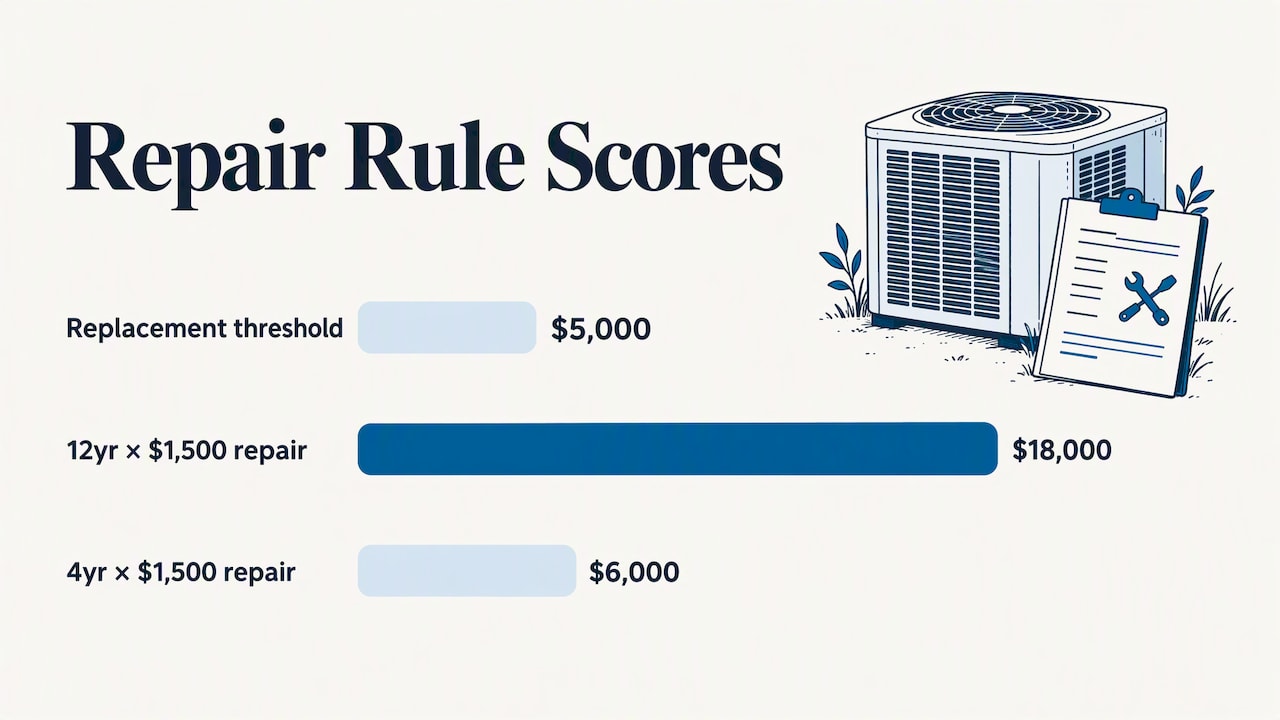
A common shortcut: multiply the system’s age in years by the repair estimate. Above $5,000, replacement is often considered; below it, repair may make more sense. A 12-year-old system with a $1,500 compressor quote scores 18,000, so the rule leans toward replacement. An 4-year-old system with the same quote scores 6,000, which is closer to the line. Treat it as a starting point. Refrigerant type, repair history and a professional’s evaluation matter too.
If you are budgeting across several years and want to see what ongoing repairs add up to, a maintenance cost calculator can help you put numbers on the repair-versus-replace question.
Don’t just swap in the same size
If you have added insulation or sealed air leaks since the system was installed, your home may need less cooling than it did. The DOE’s Building America guidance advises re-evaluating equipment size with ACCA Manual J and S methods rather than copying the old size, to avoid an oversized system. Oversizing is a particular problem in humid climates, because a unit that cools too fast shuts off before it removes moisture. If you go the replacement route, this is what a custom installation sized for Florida humidity is meant to solve.
Installation quality matters as much as the equipment. Building Science Education notes that more than half of U.S. HVAC systems are believed to underperform because of installation issues, and that following ACCA standards for sizing, charging and commissioning supports performance and longevity.
Our perspective: diagnose first, sell second
We are a veteran-owned company, and we see the same pattern across Sarasota, Bradenton, Lakewood Ranch and Venice: a homeowner calls after another company said the compressor is dead and the system needs replacing. Sometimes that is right. Sometimes the real problem is a capacitor, a contactor or a low charge, and a compressor was never the issue.
So we start with the diagnosis. We measure, we show you what we found, and we put it in a written estimate before any work starts. If a compressor swap is the sensible fix, we say so. If the system is near the end of its life, we say that too, and explain why, rather than push either option. Our priority is the number you can trust, not the biggest invoice.
We also look at why the compressor failed. In our climate, a unit that runs hard for most of the year, in salty coastal air, takes a beating. A new compressor on a system with dirty coils or poor airflow is a short-lived fix. And every job we do carries a one-year labor warranty.
The cheapest compressor repair is the one you never need. Regular tune-ups catch the electrical and airflow problems that wear compressors out, which is why we recommend preventative maintenance for any Florida system.
— Zach
Need a compressor diagnosis in Sarasota or Manatee County?
If your system has stopped cooling and you suspect the compressor, start with a diagnosis rather than a quote over the phone. Our technicians test the compressor and the parts around it, then give you a written estimate. AC repair is available same day, and for a system that has quit in the middle of a heat wave, our emergency AC repair service responds around the clock. Military members and veterans receive a discount, and financing is available if the answer turns out to be a new system.
If the diagnosis says replacement, our AC installation service sizes the new system to your home, not to the old nameplate.
Questions homeowners ask about compressor replacement
Can you replace an AC compressor yourself?
Not legally or practically for most homeowners. The job needs refrigerant recovery, brazing, a vacuum pump and a precise charge, and EPA Section 608 certification is required to service equipment that could release refrigerant. A mistake can damage the new compressor or leave you with a system that doesn’t cool. Call a licensed contractor.
How long does a compressor replacement take?
It depends on access, the cause of failure and whether the lines need cleaning after a burnout. Plan on most of a day for a straightforward job, since the vacuum and commissioning steps can’t be rushed. Your technician can give you a realistic window once the system has been diagnosed.
Is the $5,000 rule reliable?
It is a quick screen, not a verdict. It multiplies system age by the repair cost and compares the result with $5,000, as CBS News explains. Repair history, refrigerant type and efficiency should also weigh in before you decide.
What should a written estimate include?
It should name the compressor and any other parts, state the labor, and say whether it includes a new filter drier, refrigerant recovery and recharge, and vacuum and commissioning. It should also state the warranty terms. If the diagnosis is missing, ask for it.
Sources
- How Much Does an AC Compressor Cost? (2026 Guide), This Old House
- What Does AC Replacement Cost? Trane
- What is an AC Compressor? Bryant
- The Art of Troubleshooting Compressors, ACHR News
- Air Conditioner Repair Guide, Carrier
- Measure Guideline: Air Conditioner Diagnostics, U.S. Department of Energy
- Building America Best Practices Series Vol. 14, U.S. Department of Energy
- HVAC Quality Installation, Building Science Education
- Section 608 Technician Certification Requirements, U.S. EPA
- Economy, Technology Encourage HVAC System Replacements, ACHR News
- What is the $5,000 rule for HVAC systems? CBS News
Recommended
- AC Blowing Hot Air? Causes, Quick Checks and When to Call
- AC Making Loud Noise? What Each Sound Means and When to Call
- Common AC Repair Issues in Sarasota & Bradenton – And Why You Shouldn’t Wait to Call AC Heroes
- Preventative AC Maintenance in Sarasota & Manatee County: Keep Your System Running Strong with AC Heroes