
If your air conditioner is running but the air from the vents feels warm, the cause is usually one of four things: a thermostat setting, a clogged filter or frozen coil, a tripped breaker or failed electrical part at the outdoor unit, or a sealed-system problem such as a refrigerant leak or a failing compressor. The first two you can check in ten minutes. The last two need a licensed technician. In a Sarasota summer, that line matters, because a house can heat up fast and a wrong guess can turn a small repair into a big one.
This guide walks you through the checks in the order we would do them, tells you what each symptom usually means, and shows you where to stop and call.
TL;DR
- Start with the thermostat: set it to Cool, set the fan to Auto, and drop the temperature a few degrees below the room reading.
- Check the air filter and look at the indoor coil lines for ice. A dirty filter is the most common cause and the cheapest to fix.
- If the indoor fan runs but the outdoor unit is silent, or the breaker trips again right after you reset it, stop. Do not keep forcing it.
- Low refrigerant means a leak. Adding gas without finding the leak is a temporary patch, so ask for a leak test.
- Warm air with a hot house in Sarasota or Manatee County is an urgent problem. We offer same-day and emergency AC repair.
Table of Contents
- First, make sure it is really blowing hot air
- Quick checks you can do in ten minutes
- What the symptom tells you
- Refrigerant: why topping off is not a fix
- Electrical and compressor problems
- Why Florida makes this worse
- Our perspective: diagnose first, sell second
- When to stop and call a technician
- Getting help in Sarasota and Manatee County
- How to keep it from happening again
- FAQ
- Sources
First, make sure it is really blowing hot air
Before you troubleshoot, rule out three situations that feel like a failure but are not.
The system just restarted. Many units have a built-in delay that keeps the compressor off for a few minutes after a power loss or a thermostat change. The indoor fan may run and push room-temperature air while the outdoor unit waits. Give it five minutes before you decide anything is wrong.
The fan is set to On. With the fan on “On” instead of “Auto,” the blower runs continuously, including between cooling cycles, and pushes lukewarm air through the vents when the compressor is off. In humid Florida air, that can also put moisture back into the house. Set it to Auto.
The air is cool, just not cold enough. A properly working central system cools the air it pulls from the house, so the air at the vent is noticeably cooler than the room, not icy. If the vent air is only a couple of degrees below the room and the house is not catching up, that is a performance problem worth diagnosing, even if it is not strictly hot air.
Quick checks you can do in ten minutes
These are safe, need no tools beyond a screwdriver or a flashlight, and cover the most common causes. Carrier lists dirty filters, refrigerant leaks, incorrect thermostat settings and electrical issues with the compressor among the most common reasons an air conditioner blows hot air. The order below follows that list from cheapest to most serious.
1. Thermostat
- Confirm the mode is Cool, not Heat, Auto-changeover or Off.
- Set the fan to Auto.
- Lower the setpoint at least three to four degrees below the current room temperature so the system has a reason to call for cooling.
- If the screen is blank or dim, replace the batteries. A dead thermostat cannot tell the outdoor unit to start.
If you use a smart or programmable thermostat, check that a schedule or an away mode has not overridden your setting. The U.S. Department of Energy notes that raising the setting while you are away can save energy, but a schedule that is wrong for your day will leave you warm at home.
2. Air filter
Pull the filter out and hold it up to a light. If you cannot see light through it, replace it. Consumer Reports names a dirty filter as the most common air conditioner problem, and the Department of Energy explains that a clogged filter restricts airflow, which lowers efficiency and the unit’s ability to cool the air.
In Florida, where systems run most of the year, a filter that was fine in spring may be choked by midsummer. Homes with pets, construction dust nearby or a lot of door traffic clog filters faster.
3. Ice on the indoor unit or refrigerant line
With the system off, look at the larger copper line going into the outdoor unit and at the indoor coil if you can see it. Frost or ice means airflow or refrigerant is off. The usual causes are a dirty filter, a blocked return, a weak blower or low refrigerant.
If you find ice:
- Turn the thermostat to Off and the fan to On so air moves over the coil and melts it.
- Let it thaw fully, which can take several hours. Do not chip at it.
- Replace the filter.
- Restart. If the ice returns, you have a deeper problem, most often airflow or a leak, and it needs a technician.
Running an iced coil in cooling mode is a fast way to damage the compressor, so do not leave it running to see if it clears.
4. Outdoor unit
Stand a safe distance from the condenser while the system is calling for cooling. You want to see the fan spinning and hear the compressor humming. Check for obvious blockage: leaves, grass clippings, a fence panel, or landscaping too close to the unit. Clear anything within a couple of feet. Do not spray the coil with a pressure washer, which can bend the fins.
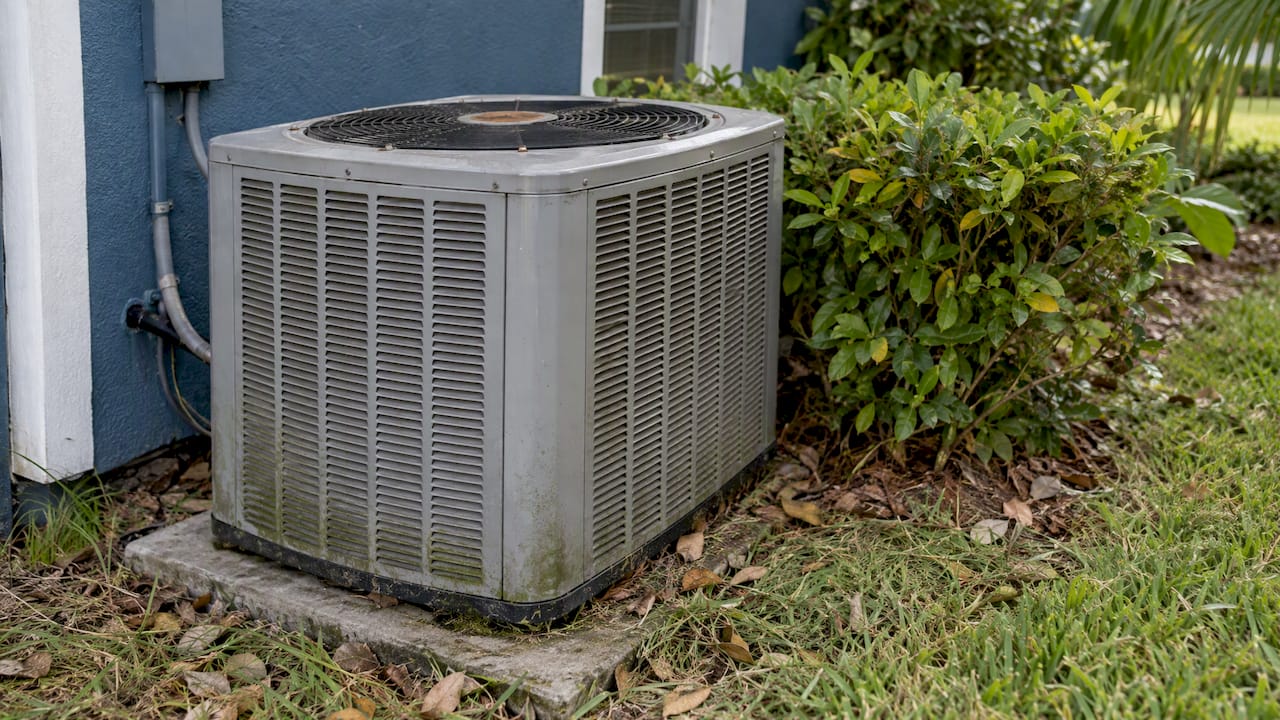
If the fan is not running, or the unit hums but the fan does not turn, stop. That points to a failed capacitor or motor.
5. Breaker and disconnect
Your air handler and your outdoor condenser are usually on separate breakers, and there is often a disconnect box near the outdoor unit. Check that both breakers are on and the disconnect is seated. A tripped breaker can leave the indoor fan running while the outdoor unit has no power, which is a classic cause of warm air.
You may reset a tripped breaker once. If it trips again right away, leave it off and call us. Repeated forcing can point to a hard-starting compressor or shorted capacitor, and pushing power into it can damage the contactor or the motor and turn a modest part replacement into a much larger repair.
What the symptom tells you
Use this table to match what you see to the likely cause and who should handle it.
| What you notice | Likely cause | You or a pro? |
|---|---|---|
| Warm air, system just restarted | Compressor delay, normal | Wait five minutes |
| Warm air, fan set to On | Fan running between cooling cycles | You: switch to Auto |
| Weak airflow, warm air, filter is gray | Clogged filter | You: replace it |
| Ice on coil or refrigerant line | Airflow or refrigerant problem | You thaw, pro finds the cause |
| Indoor fan runs, outdoor unit silent | Power, capacitor, contactor or compressor | Pro |
| Outdoor unit hums, fan does not spin | Failed capacitor or motor | Pro |
| Breaker trips again after one reset | Electrical fault, hard-starting compressor | Pro, leave breaker off |
| Hissing, oily residue, ice returns | Refrigerant leak | Pro |
| Starts cool, turns warm after an hour or two | Frozen coil, overheating, or failing component | Pro |
Refrigerant: why topping off is not a fix
Refrigerant is not a consumable like fuel. A sealed system should hold its charge for years. If the charge is low, it is leaking somewhere, usually at a coil, a joint or a fitting.
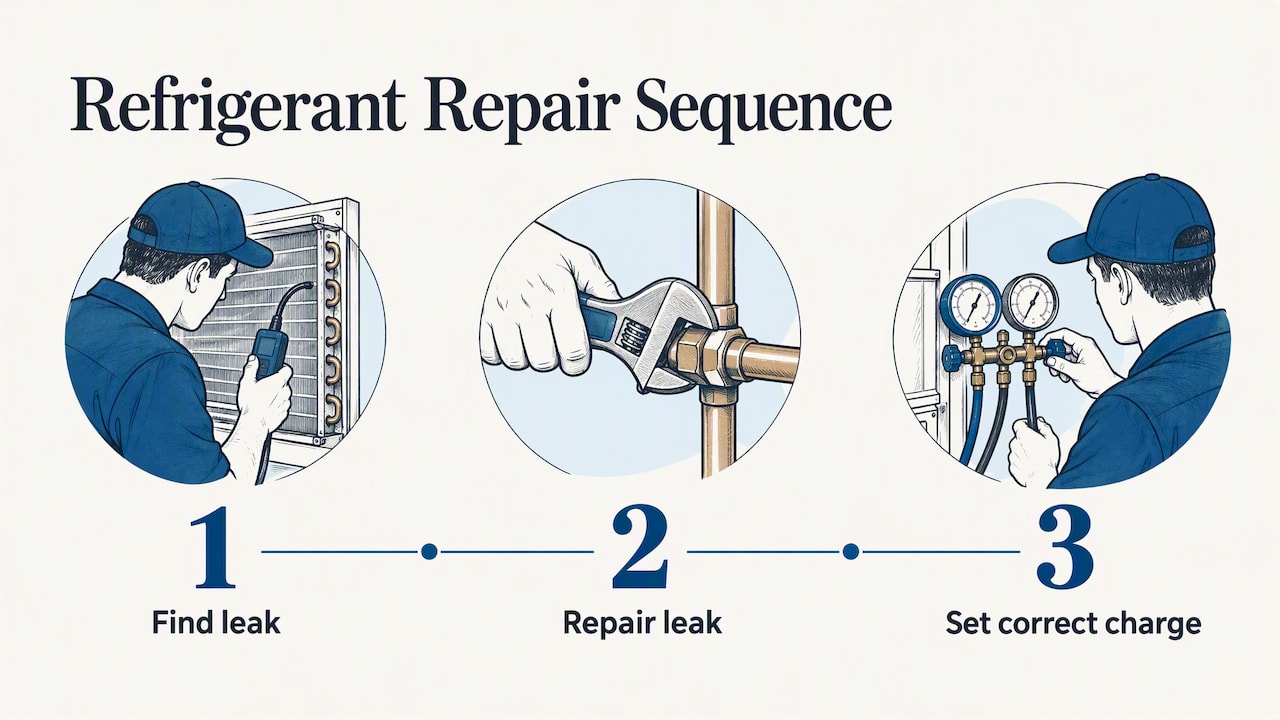
The common shortcut is to add refrigerant and move on. That brings cold air back for a while, but the leak is still there, so the problem returns, often in the hottest week of the year, and you pay again. The better order is to find the leak, repair it, then set the correct charge. Ask any contractor, including us, whether the quote includes a leak test.
Older systems add another wrinkle. R-22 refrigerant, used in many older units, is no longer produced or imported in the U.S. The EPA’s phaseout notice says that after 2020 only recovered or reclaimed R-22 is available for servicing existing equipment. If your system uses R-22 and has a leak, the cost-and-benefit math of repairing versus replacing changes, and an honest technician will lay out both options with written numbers.
Refrigerant work must be done by a licensed professional. It is not a homeowner job, and a can from a store does not tell you why the system lost charge.
Electrical and compressor problems
When the indoor fan is blowing but the outdoor unit is silent, you do not have a cooling problem, you have a power or compressor problem, and no filter change will fix it. The usual suspects, roughly from least to most costly, are:
- Capacitor. A small part that helps the compressor and fan motor start. Common in hot climates, often a quick repair when caught early.
- Contactor. The switch that sends power to the outdoor unit. Pitted or stuck contacts can keep the unit from starting.
- Fan motor. If the condenser fan does not spin, the unit overheats and shuts down on protection.
- Compressor. The heart of the system. If it has failed, you will weigh repair against replacement, especially on an older unit.
Catching a weak capacitor early is the reason we prefer to diagnose before replacing anything. A cheap part that fails under load can take a much more expensive part with it.
Why Florida makes this worse
In Sarasota and Manatee County, your AC is not a seasonal appliance. It runs through most of the year, and it is doing two jobs: lowering temperature and removing moisture. When airflow drops or the system loses charge, it does both jobs badly.
That has a health side. The CDC notes that mold can enter a home through heating and air conditioning systems, and a system that is not cooling properly is also not dehumidifying properly. If the house is warm and sticky for days, take it seriously. If anyone at home has asthma, allergies or other breathing issues, or you notice a musty smell, call a professional sooner rather than later, and ask about the condition of your ducts and filters as part of the visit.
Ducts matter for another reason. If supply ducts leak into an attic or are poorly connected, cold air never reaches the room, and the vent can feel weak or warm even when the equipment is fine. The Department of Energy’s cooling guide covers this too, and we see it in older Florida homes where attic ducts have aged. Our ductwork repair and replacement and air duct cleaning services address those cases.
Our perspective: diagnose first, sell second
We are a veteran-owned company, and we built AC Heroes on one rule: figure out why the system failed before proposing any repair. Warm air is a symptom, not a diagnosis. The same complaint can come from a $10 filter or a dead compressor, and a homeowner standing in a hot house cannot tell which by feel.
Here is what that looks like in practice:
- We check the basics first, thermostat, filter, airflow, power, because that is where the answer often is. Many HVAC professionals will tell you the most common cause is simply a dirty filter, and we would rather tell you that than sell you something you do not need.
- We measure instead of guessing. If refrigerant is low, we want to find where it went.
- We put the estimate in writing, with the reason for each line, before any work starts.
- We stand behind the work with a one-year labor warranty on all work, and we handle manufacturer warranty work.
What we do not like is the scare quote: a high number, a short deadline and a recommendation to replace the system before anyone has opened the unit. Sometimes replacement really is the right call, and when it is we will show you why. But it should come after the diagnosis, not instead of it.
If you want a second opinion on a quote you received for warm air, we are happy to look at what was found and what was proposed.
— Scott
When to stop and call a technician
Call a professional right away if any of these apply:
- The outdoor unit will not start, or hums without the fan turning.
- The breaker trips a second time.
- You smell burning, see sparks, or hear grinding or loud banging.
- Ice comes back after you have thawed it and replaced the filter.
- You can see oily residue on refrigerant lines or hear hissing.
- The system turns on cool and drifts warm after a short run.
- Someone in the home is elderly, an infant, medically fragile, or has a respiratory condition, and the house is heating up. In that case treat it as urgent and think about where the person can stay cool while you wait for service.
Turn the system off at the thermostat while you wait, especially if you suspect ice, a bad breaker or a burning smell. Running a failing system can add to the damage.
Getting help in Sarasota and Manatee County
We handle warm-air complaints across Sarasota and Manatee Counties, including Lakewood Ranch, Venice and Longboat Key. Our AC repair service starts with a full diagnostic and a written estimate. If the house is already hot, our emergency AC repair line is built for same-day response, with 24/7 urgent service. Military members and veterans can ask about discounts, and we can talk through financing if the fix turns out to be a larger one.
If your AC repair history is long and the system is older, our AC installation team can size a replacement for Florida humidity, so you are not buying equipment that is too big and cycles on and off without removing moisture.
How to keep it from happening again
Most warm-air calls trace back to something that could have been caught earlier.
- Change the filter on a schedule. Check it monthly during the cooling season and replace it when it is dirty. Many Florida homes need changes more often than the box suggests.
- Keep the outdoor unit clear. Trim plants back and keep mulch, grass and debris away.
- Watch the drain line. A clogged condensate line can shut the system down or cause water damage. Slow drainage is an early warning.
- Schedule preventative maintenance. A technician can check capacitors, contactors, coils, airflow and refrigerant levels before one of them fails on a 95-degree afternoon. We offer preventative AC maintenance with annual and semi-annual programs. You can also read our guide on preventative maintenance in Sarasota and Manatee County.
- Know the early signs. Longer run times, higher energy bills, weak airflow and rising indoor humidity come before most failures. Our post on signs your AC needs professional repair walks through them.
FAQ
Why is my AC blowing hot air all of a sudden?
A sudden change usually means something simple has changed or something has failed outright. Check the thermostat mode and fan setting, the filter and the breakers first. If the outdoor unit is silent or the breaker keeps tripping, a capacitor, contactor or compressor problem is likely and needs a technician.
Is it safe to keep running my AC if it is blowing warm air?
Not if you see ice, smell burning or hear grinding. Running a system with a frozen coil or an electrical fault can damage the compressor. Turn it off at the thermostat, thaw any ice with the fan on, and call for service if the problem persists.
Can low refrigerant be fixed by just adding more?
Only temporarily. Refrigerant circulates in a sealed system, so low levels mean a leak. Adding gas without finding and repairing the leak usually means the problem returns, and you pay again. Ask for a leak test and a written estimate.
Should I leave the fan on Auto or On?
Auto is the better choice for most homes. With the fan on Auto, the blower runs only when the system is cooling. With it on, the fan keeps moving air between cycles, which can feel warm and, in humid weather, can add moisture back into the house.
Is it better to keep the AC on all day in Florida?
A steady temperature is generally easier on the system than big swings, because a long recovery run uses a lot of energy. A modest setback when nobody is home is fine, but avoid dropping the setpoint dramatically to cool the house fast.
Sources
- Carrier: Why is my AC blowing hot air?
- Consumer Reports: 8 air conditioner problems and how to fix them
- U.S. Department of Energy: Tips for lowering your cooling costs
- EPA: Phasing out HCFC refrigerants to protect the ozone layer
- CDC: Mold