
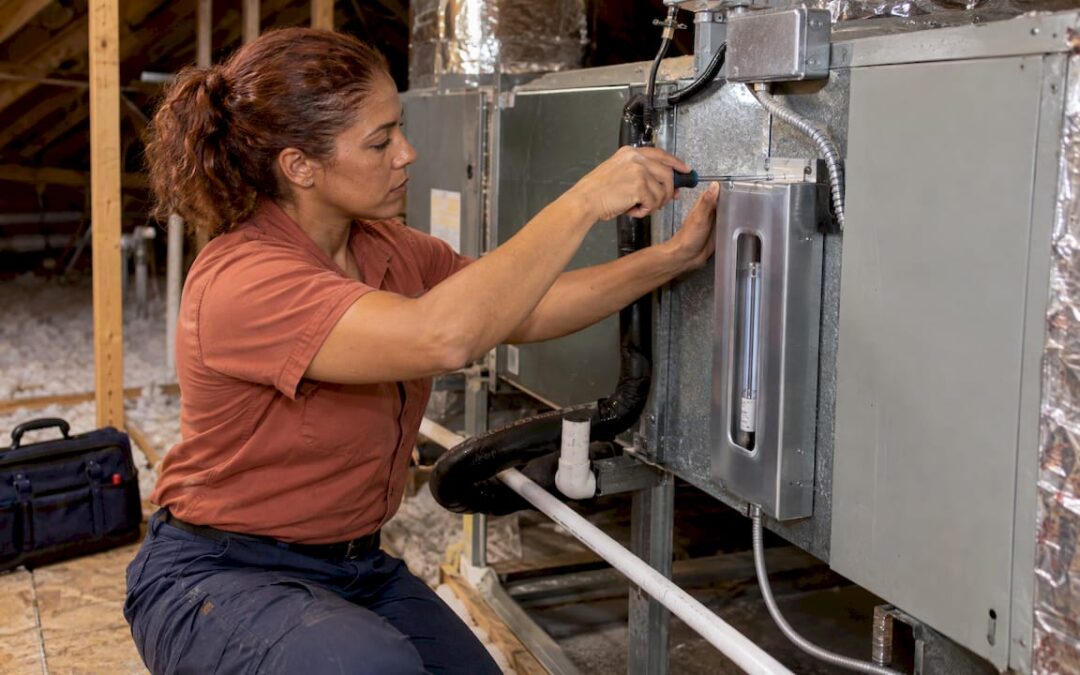
A whole-home air purifier is installed in your central HVAC system, usually in the return side of the air handler or furnace. Because it involves sheet metal, wiring and your system’s airflow, a qualified HVAC technician should do it. A standard job typically takes one to three hours, and the right unit depends on your equipment, your ductwork and what you want to remove from the air. In Sarasota and Manatee Counties, humidity is part of that decision.
This guide explains what gets installed, where it goes, how the work is done, how to keep it running and when a portable unit is the better fit for a room.
Key Takeaways
- Duct-mounted purifiers clean air only while your HVAC fan runs, so they work together with your system, not apart from it.
- The usual location is the return side of the air handler or furnace, never the warm supply side.
- Installation involves high voltage, sharp sheet metal and, for UV, eye hazards. Manufacturers call for a qualified HVAC professional.
- Your system must handle the added resistance of a higher-efficiency filter. A technician should check fit and airflow before anything goes in.
- Portable HEPA units and whole-home systems do different jobs. Many homes benefit from both.
Table of Contents
- What “air purifier installation” actually means
- Types of whole-home purifiers that can be installed
- Where the purifier goes in your system
- How the installation works, step by step
- What it costs
- Keeping it working
- Whole-home or portable: which fits your situation
- Get your air purifier installed by AC Heroes
- FAQ
- Sources
What “air purifier installation” actually means
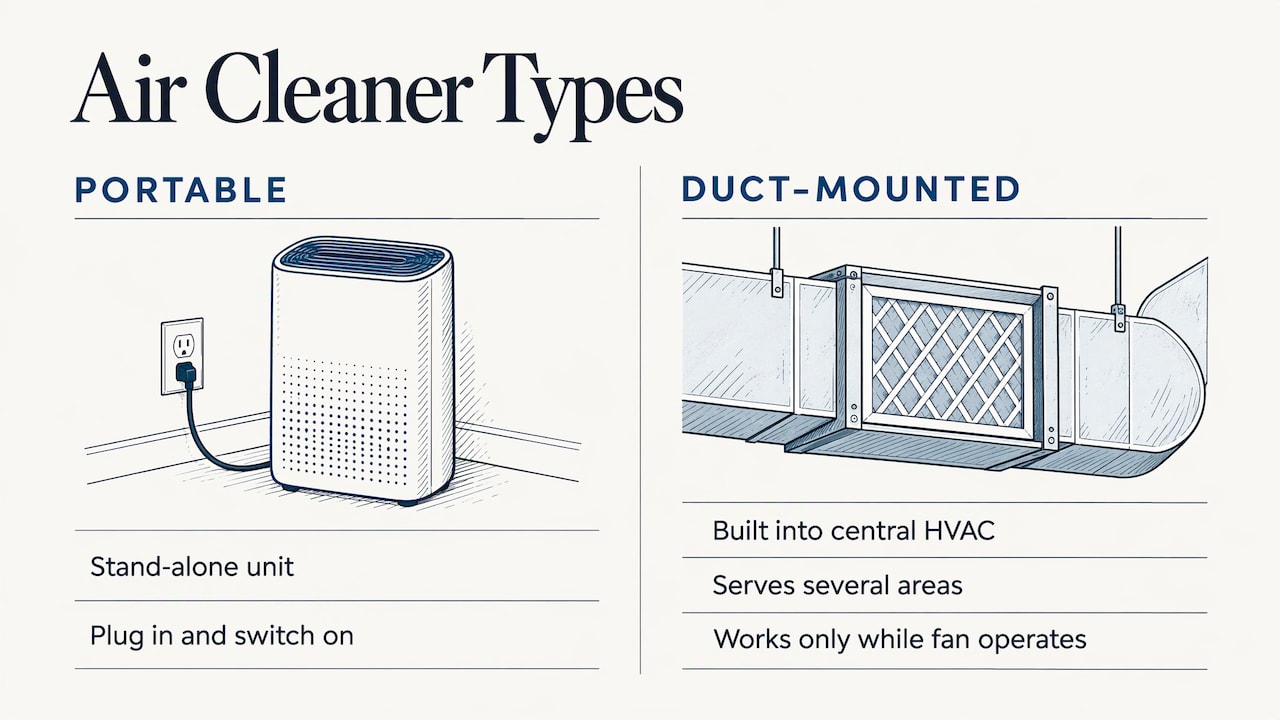
Two things get called an air purifier. One is a portable, stand-alone unit you plug in and switch on. The other is equipment built into your central heating and cooling system. The EPA describes these as two basic categories of residential air cleaners: portable cleaners, and HVAC or furnace filters and other duct-mounted cleaners. Duct-mounted devices can serve several areas of the house, but only while the HVAC fan is operating.
When homeowners search for installation, they almost always mean the second kind. That is what this article covers.
Types of whole-home purifiers that can be installed
The EPA technical summary lists these duct-mounted technologies: fibrous-media filters, electronic air cleaners such as electrostatic precipitators and ionizers, ultraviolet germicidal irradiation (UVGI), and gas-phase media. Here is how they differ in practice.
| Type | What it does | Where it typically goes |
|---|---|---|
| High-efficiency media filter | Traps particles as air passes through a thick pleated filter | Return side of the air handler or furnace, in a filter cabinet or slot |
| Electronic air cleaner | Uses an electrical charge to capture particles | Return or cold-air section, sometimes a central return grille |
| UV light | Treats surfaces and air near the coil with ultraviolet light | Return duct near the unit, or near the evaporator coil and drain pan |
| Gas-phase media | Targets gases and odors rather than particles | In the duct system, per the manufacturer |
The return-side placement for electronic cleaners comes from AHRI’s guidance on air filtration and UV treatment, which says they are commonly installed in the return or cold-air section.
Filters: the simplest upgrade
The EPA’s consumer guide recommends at least a MERV 13 filter, or as high a rating as your system’s fan and filter slot can accommodate, and says to consult a professional about compatibility. The American Lung Association likewise suggests upgrading to a filter rated preferably MERV 13 or above.
Fit matters. The EPA notes that a higher-efficiency filter must sit snugly without bending or crushing, and that common residential filter thicknesses run from 1 to 5 inches. A filter that bows in its slot lets air slip around it. A technician measures the slot, checks your blower and picks a size that works.
UV lights and Florida humidity
AHRI recommends placing UV lights in the return duct near the unit or, preferably, near the evaporator coil and drain pan, because those dark, damp components can support biological growth. That is relevant here. Coils in a Gulf Coast home run wet for much of the year. If you have noticed musty smells, read our guide to mold in your HVAC system and tell your technician, so the purifier choice and placement fit what the system is actually doing.
Where the purifier goes in your system
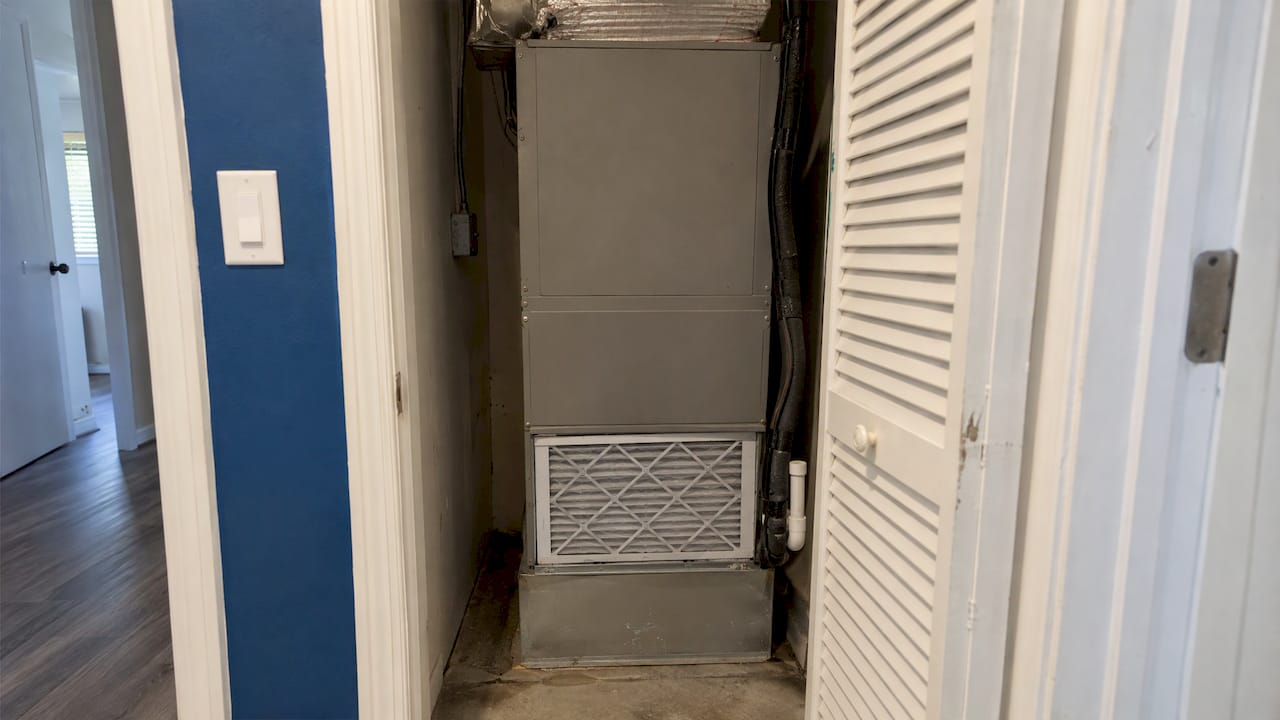
The short answer is the return side. The EPA says furnace filters and other duct-mounted cleaners are installed at the base of the air-handling unit or upstream in return grilles.
Manufacturer documents agree:
- One major manufacturer’s installation guide says the filter enclosure belongs in the return-air duct on the entering-air side of a central furnace or air handler, not in the discharge-air stream.
- A UV purifier installation manual places the unit directly on the return side of the air handler or gas furnace, as close to the return side as possible.
- A media air cleaner installation manual says not to install the unit in the warm-air supply or anywhere temperature can exceed 140°F. It also says not to put it downstream of a UV light, because UV can degrade filter media.
That last point is why combining a media filter and a UV light needs planning. The order in the duct matters, and a technician who has the manuals for both products gets it right the first time.
Many Florida systems have tight spaces
Air handlers in garages, closets and attics leave little room to work. One manufacturer’s guide requires at least 28 inches of clearance in front of the enclosure so the filter can be removed later. If your air handler sits in a tight attic platform, tell us before the visit. Access is one of the things that decides whether a purifier can be added to the existing cabinet or needs a different approach.
How the installation works, step by step
This is the process you can expect from a licensed technician. It is not a DIY procedure.
- Inspection and diagnostics. The technician looks at your air handler or furnace, return location, filter slot, blower and ductwork. Airflow is checked first, because a purifier adds resistance.
- Matching the product to the system. Type, size and filter depth are chosen for your equipment and your goals, such as dust, pet dander, odors or coil cleanliness.
- Power off. Manufacturers call for disconnecting power before installation or servicing.
- Mounting. Housings attach to the cabinet or return duct. For a UV unit, the housing mounts on the return side as close to the air handler as practical. Sheet metal is cut or fitted. Edges are sharp, which is one reason the manuals warn about it.
- Electrical connection. Powered units need a safe connection. The media cleaner manual warns that high voltage can cause serious injury and says installation should be performed by a qualified heating and air-conditioning professional.
- Orientation and sealing. Filters are installed with the airflow arrow pointing toward the furnace or air handler. AHRI says a filter face should sit at right angles to airflow, with even airflow across it and service space for inspection and replacement.
- Startup check. The technician runs the system, checks for air leaks around the housing, confirms the unit is powered and listens for changes in blower sound.
A contractor guide reports that standard systems typically take one to three hours, with more time for multiple zones, hard-to-reach equipment or complex ductwork.
Why a professional should do it
The UV manual states that qualified technicians should install the unit, and it tells users to protect their eyes from UV light and disconnect power before servicing. The same applies to any unit that is wired in. A mistake can mean shock, a leaky cabinet that pulls in unfiltered attic air, or a blower working against too much restriction. Our job is to see that none of that happens.
What it costs
Price depends on the type of purifier, the condition and layout of your ductwork, access to the air handler, electrical needs and the number of systems in the home. A simple filter-cabinet upgrade and a wired-in UV or electronic unit are very different jobs, and homes with multiple zones multiply the work.
We do not publish a flat price, because quoting without seeing your system leads to the surprise add-ons we try to avoid. Our approach is diagnostics first and a transparent written estimate after, so you know what is included before work starts. We offer financing options, and veterans and active military get a discount.
Keeping it working
Installation is the start. Maintenance decides whether the purifier keeps doing its job.
- Replace media on schedule. One media cleaner owner’s manual recommends replacing its media annually, while noting that the right frequency varies with runtime, occupants, pets, carpeting, smoking, home size and local pollution. Florida systems often run nearly year-round, so expect to be on the shorter end.
- Change ordinary filters regularly. The American Lung Association says typical disposable HVAC filters should be changed about every two months or when dirty, and suggests holding the filter against white paper to judge how soiled it is.
- Keep the fan doing its job. Duct-mounted cleaners filter only while the system fan runs. Your thermostat’s fan setting affects how much air passes through the purifier.
- Have it checked during tune-ups. Housings, UV lamps and seals should be inspected with the rest of the system. Our preventative AC maintenance includes annual and semi-annual programs, and our guide on how often to service your AC in Sarasota and Bradenton explains the schedule that suits Florida conditions.
Dirty ducts can undercut even a good purifier. If dust or odors keep coming back, look at professional air duct cleaning alongside the installation, and see why it matters in our Sarasota and Bradenton duct cleaning guide.
Whole-home or portable: which fits your situation
Portable cleaners are stand-alone units that must be plugged in and turned on. Duct-mounted systems integrate with your central HVAC and depend on the blower, as the EPA technical summary explains.
The American Lung Association’s guidance supports both: portable HEPA cleaners for targeted rooms and central filtration for whole-home coverage. It recommends placing a portable unit in the rooms where vulnerable occupants spend the most time, keeping doors and windows closed while it runs, and choosing a HEPA unit with a high CADR suited to the room size.
| Situation | Good fit |
|---|---|
| You want cleaner air in every room, with the AC already running daily | Whole-home system |
| One bedroom matters most, such as for a family member with allergies | Portable HEPA unit in that room, plus central filtration |
| Musty odors or coil concerns | Whole-home system with a UV light near the coil, after an inspection |
| A ductless mini-split without ductwork | Portable units or the manufacturer’s own filtration options |
Mini-split systems have a different rule set. One manufacturer’s manual requires authorized-dealer or specialist installation and qualified electrical work, and warns that a defective installation can cause water leakage, electrical shock or fire.
Our take on air purifier installation
We see the same pattern across Sarasota and Manatee Counties. A homeowner buys a purifier, or gets pitched an expensive one, before anyone has looked at the system it will live in. That is backwards. In our climate the AC runs most of the year, the coil stays wet, and the ductwork carries the humidity. The purifier has to suit that environment.
That is why we start with diagnostics. We look at the airflow, the filter slot, the coil and the ducts, then tell you in a written estimate what makes sense and what does not. We would rather install one part that fits your system than sell you a package of parts you do not need.
We are a veteran-owned company, and we stand behind our work with a one-year labor warranty. If you want cleaner indoor air, start with an honest look at the system you have.
Zach
Get your air purifier installed by AC Heroes
We serve homeowners across Sarasota, Manatee, Lakewood Ranch, Venice and Longboat Key. For indoor air quality work, we inspect your system first, explain the options that fit it, and give you a written estimate before work begins. Our work carries a one-year labor warranty and a satisfaction guarantee, and military and veteran discounts apply.
Ready to talk through your options? Visit our indoor air quality page to get started, or ask about adding a purifier at your next tune-up. If your system is not cooling properly, AC repair comes first, because a purifier cannot do its job on a struggling system.
FAQ
How much does it cost to install a central air purifier?
It depends on the type of unit, the condition of your ductwork, access to the air handler and whether new electrical work is needed. A filter upgrade is a smaller job than a wired-in electronic or UV system. We provide a transparent written estimate after inspecting your system.
Where is the best place to put an air purifier?
For a whole-home system, the return side of your air handler or furnace, not the warm supply side. For a portable unit, the room where the most vulnerable person spends time, with doors and windows closed while it runs, per the American Lung Association.
Can I install a whole-home purifier myself?
Manufacturer manuals say installation should be done by a qualified HVAC professional. The work involves high voltage, sharp sheet metal and, with UV units, eye hazards. It also needs a check of airflow and filter fit. We recommend having a technician handle it.
How long does installation take?
A contractor guide reports one to three hours for standard systems. Multiple zones, hard access or complex ductwork can add time. We confirm the scope during our inspection.
Does a purifier work when the AC is off?
No. Duct-mounted cleaners filter air only while the HVAC fan is running. In homes where you want constant filtration, a technician can advise on fan settings, and a portable HEPA unit can cover a key room.
Sources
- Guide to Air Cleaners in the Home, US EPA
- Residential Air Cleaners: A Technical Summary, US EPA
- Air Cleaning, American Lung Association
- Air Filtration and Ultraviolet Light Treatment, AHRI
- Residential HVAC installation guide, filter enclosure
- UV purifier installation and maintenance manual
- Media air cleaner installation manual
- Media air cleaner owner’s manual
- Whole House Air Purification System: Types, Costs & Setup
- Mini-split system owner’s manual