
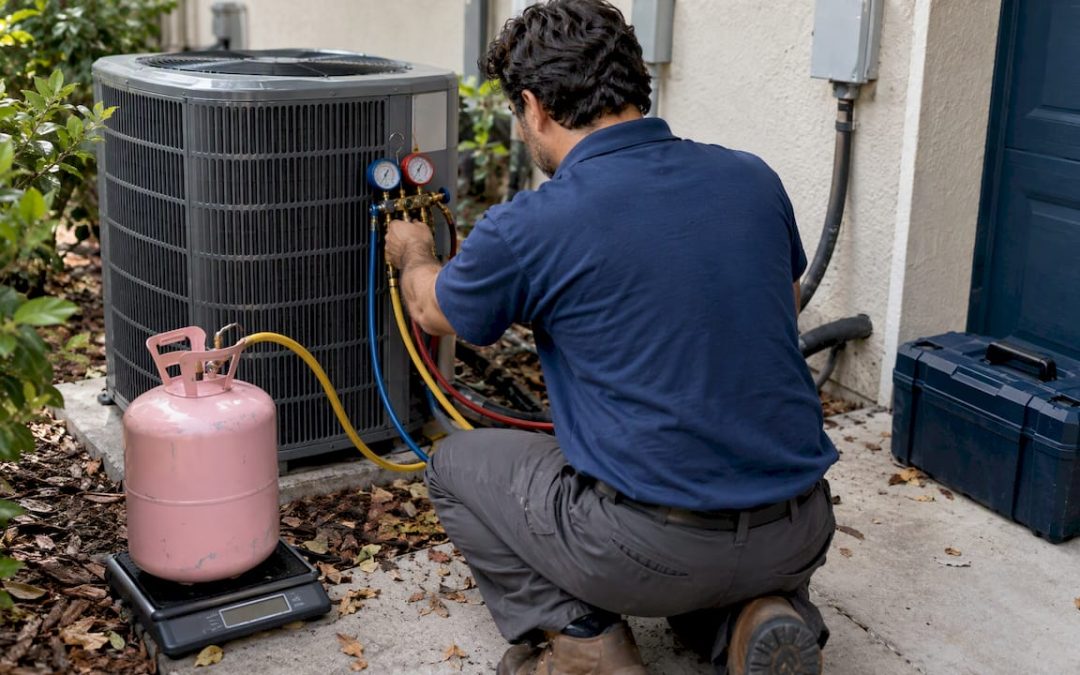
A home AC refrigerant recharge restores the refrigerant in your system to the level the manufacturer specifies. Your AC does not use refrigerant up, so if it is low, there is a leak, and a proper recharge means finding and fixing that leak first. Federal law also limits who can add refrigerant to a home system. If your AC in Sarasota or Manatee County is running but not cooling, the right first call is a licensed, EPA-certified technician who diagnoses before they sell. That is how we work at AC Heroes: thorough diagnostics before any work and a written estimate you approve.
Key Takeaways
- Refrigerant moves through a sealed loop and is not consumed in normal operation. Low refrigerant points to a leak.
- A topped-off leak comes back. EPA tells owners to ask for the leak to be located and repaired rather than simply topped off.
- Federal rules require Section 608 certification to recharge a system, and refrigerant for home AC is sold only to certified technicians or their employers.
- Warm air, ice on the coil, hissing or nonstop running are the usual signs. Turn the system off if it is frozen and call.
- Ask for a written estimate that separates diagnosis, leak repair and refrigerant, so you know what you are paying for.
Table of Contents
- What a home AC recharge actually is
- Signs your AC is low on refrigerant
- What to do before you call
- Why you cannot recharge your own home AC
- How a proper recharge works, step by step
- What a recharge costs
- R-22 and R-410A: what the rules mean for your system
- Why Florida systems feel a low charge sooner
- Our view: a recharge is the end of the job, not the job
- Book a diagnosis from AC Heroes
- What to ask any technician before approving a recharge
- FAQ
- Sources
What a home AC recharge actually is
People often call it “adding Freon.” Freon is a brand name that stuck. The real term is refrigerant, the fluid that carries heat out of your house. A recharge replenishes it to the manufacturer’s specified level, restoring the pressure the system needs to move heat.
Here is the part that surprises most homeowners. A sealed residential AC reuses the same refrigerant over and over. According to Trane’s guidance, it could run its whole lifespan without a recharge, and one is needed only when something is wrong, such as a leak.
That changes how you should think about the service. A car needs gas because the engine burns it. Your AC does not burn refrigerant. If a technician says the system “just needs a charge” and offers nothing about where it went, you have been told half the story.
Signs your AC is low on refrigerant
Low refrigerant rarely shows up as a single dramatic failure. It tends to build. Trane lists these possible signs:
- A frozen evaporator coil, the indoor coil that absorbs heat from your air
- Hissing or bubbling near the refrigerant lines
- An AC that runs nonstop
- Warm air from the vents
- Higher cooling costs
In Florida, the nonstop running and the bill are often the first things people notice, because the system fights humidity all year. Several of these signs also come from other faults, such as a dirty filter, a failing fan or an electrical problem. That is exactly why guessing is expensive.
Our guide on what to check when your AC blows hot air walks through the causes in more detail.
What to do before you call
There are a few safe checks worth doing once. USA Today’s homeowner guidance suggests confirming the thermostat is set to cool, replacing a visibly dirty filter, clearing debris from around the outdoor unit and checking the breaker.
If you see ice on the refrigerant lines or coil, turn cooling off and let it thaw. Running a frozen system can make things worse. Do not open any part of the refrigerant circuit or try to add refrigerant yourself.
Call a technician promptly if you notice:
- Hissing or bubbling sounds
- Ice that returns after thawing
- Warm air that persists after the basic checks
- A burning smell or smoke
A burning smell or smoke is the one to treat as urgent: switch the system off at the thermostat and the breaker, and call. Our emergency AC repair service responds around the clock, and we cover areas such as Lakewood Ranch and Venice.
Why you cannot recharge your own home AC
You will find DIY recharge kits for cars. Home systems are a different matter, and the rules are federal.
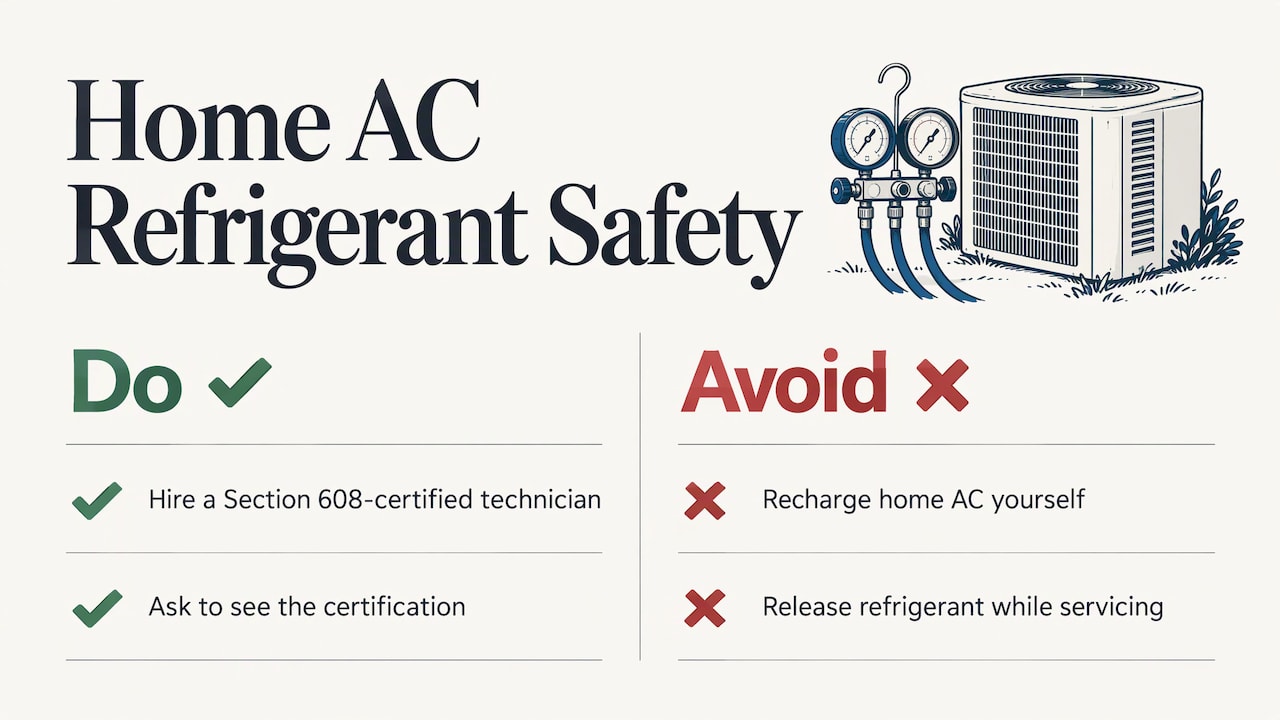
EPA states that Section 608 certification is required to recharge appliances. Refrigerant for stationary equipment is sold only to certified technicians or their employers. Intentionally releasing refrigerant while servicing AC equipment is illegal, and EPA says that applies to HCFC-22 and to substitutes such as the HFC R-410A used in many newer systems.
There is a practical side too. Trane notes that refrigerant work takes specialized training, equipment and protective gear. Even with a gauge, the amount in the system is only part of the picture. Without airflow checks and measurements, a charge can be wrong in either direction, and an overcharged system can be as inefficient as an undercharged one.
What you do control is who you hire. EPA recommends choosing reputable dealers whose technicians are Section 608 certified and says it is appropriate to ask to see the certification.
How a proper recharge works, step by step
A reliable recharge is closer to a sealed-system repair than to topping off a tank. Carrier describes the sequence this way: locate the leak, recover the remaining refrigerant, repair or replace the damaged part, pressure-test, evacuate the system, then weigh in the specified charge while watching superheat and subcooling. Here is what each step takes and where it goes wrong.
1. Rule out other faults
Bryant’s recharge guide says a technician should first rule out airflow, compressor, electrical and other problems. This is where a rushed visit fails. If a clogged filter or a weak blower is the real cause, adding refrigerant treats nothing and can leave you with an overcharged system.
2. Check the charge the right way
The U.S. Department of Energy’s Building America diagnostic guideline says the most accurate charge check uses superheat and subcooling measurements with manifold gauges, after airflow has been checked. A temperature drop across the coil can hint at a charge problem, but it needs follow-up testing. A technician who judges the charge by feel or by one pressure reading is guessing.
3. Find the leak
This is the step that separates a repair from a top-off. EPA’s Section 608 Q&A lists ultrasonic testing, gas-imaging cameras, bubble tests and compliant leak detectors as leak-inspection methods. Pressure or vacuum decay alone can show that a system leaks but cannot show where, so it is not a full inspection by itself.
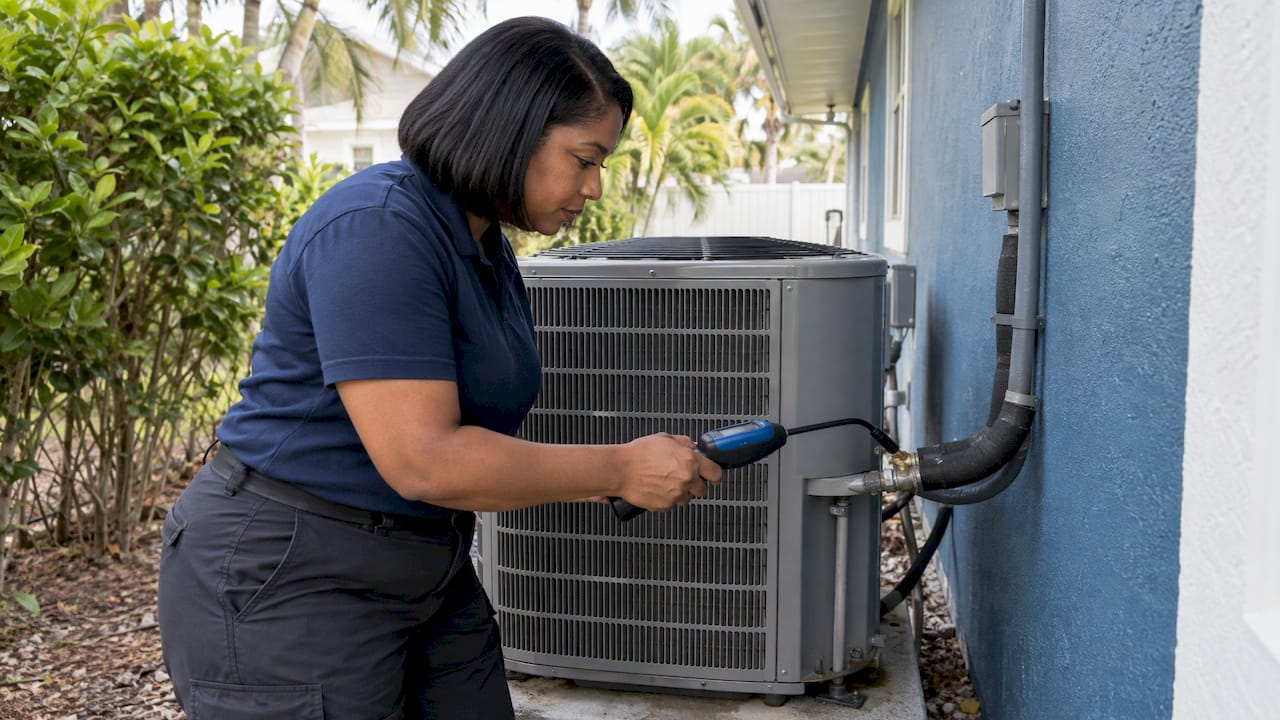
The DOE guideline adds that very low-charge systems can be leak-tested by pressurizing with nitrogen, with 150 psig for 10 minutes as its diagnostic reference. Where it goes wrong: a leak can sit in the indoor coil, a fitting, a line set or the outdoor unit, and a quick look often misses it.
4. Repair, test and evacuate
The damaged component is repaired or replaced and the system is pressure-tested. EPA says the repair should be verified before refrigerant is added. The system is then evacuated, meaning air and moisture are pulled out, because both harm the system’s performance.
5. Weigh in the charge and verify
The technician adds the manufacturer-specified amount by weight and confirms performance with superheat and subcooling readings. The specified amount is on the unit’s data plate, so you can ask what number was used and what was added.
At AC Heroes, our approach is diagnosis before any sales pitch, then a written estimate before work begins. You see what is wrong and what it costs before you approve anything.
What a recharge costs
There is no honest flat price, because the price depends on what is wrong. Several things move the total: the refrigerant type and amount, labor, diagnostic fees, whether a leak repair is needed, evacuation, unit size and how easy the equipment is to reach. One 2026 cost estimate puts a typical R-22 recharge between $350 and $1,200 under its stated Midwest assumptions. Florida prices, newer refrigerants and big leaks can land elsewhere, so treat it as a rough frame, not a quote.
What matters more than the headline number is what it buys:
| Quote type | What you get | What to expect |
|---|---|---|
| Top-off only | Refrigerant added, leak untouched | Cooling returns for a while, then the problem repeats |
| Diagnosis, leak repair and recharge | Leak found and fixed, system charged to spec | Costs more up front, treats the cause |
| Repair is no longer sensible | Replacement estimate | Common when the leaking part is the coil or compressor on an older system |
EPA notes that fixing the leak reduces emissions, repeat service, operating costs and energy waste. Paying twice for the same refrigerant is the costliest route.
Ask for the estimate in writing, with diagnosis, leak repair and refrigerant listed separately. We give written estimates and stand behind our work with a one-year labor warranty.
R-22 and R-410A: what the rules mean for your system
If your system is older, it may use R-22, also called HCFC-22. EPA says existing R-22 equipment may keep operating and does not have to be replaced. No new R-22 has been allowed to be made or imported in the U.S. since January 1, 2020, though properly reclaimed R-22 is still available.
So a leak in an R-22 system is a real decision point. Reclaimed supply is limited, and each leak repair is worth weighing against the age of the equipment. If the compressor is the failing part, our guide to AC compressor replacement explains the cost and when replacing the system makes more sense. When you do decide on a newer system, we size custom AC installations for Florida humidity.
Newer systems commonly use R-410A, which EPA also says must not be knowingly vented. Federal refrigerant rules have been changing: EPA proposed changes to R-410A installation deadlines in September 2025, and a proposal is not a final rule. ACHR News reported that residential AC and heat pumps are exempt from the 2026 leak-repair obligations. You do not need to track those details. The practical point is the same: a certified technician handles the refrigerant, and you ask for the leak to be fixed.
Why Florida systems feel a low charge sooner
Our systems run longer than almost anywhere else in the country. Long cooling seasons and constant humidity mean a system with a weak charge does not coast: it runs nonstop, ices up and drives up the bill. That is why a small leak in Sarasota can turn into a no-cooling call on the hottest week of the year.
Two habits cut the odds. First, schedule a checkup before summer, so a developing problem is found while it is still small. Our preventative AC maintenance is available as annual or semi-annual programs. Second, do not wait out the early signs. Our post on five signs your AC needs professional repair covers what to watch for before the season starts.
Our view: a recharge is the end of the job, not the job
We get a lot of calls that start with “I think I just need Freon.” We understand why. It is the answer people have heard for years. But a system with low refrigerant has a leak, and the leak is the problem you are paying to solve.
Our approach is built on that. We diagnose thoroughly before we talk about parts or prices, because the local market has a habit of scare quotes and upselling, and homeowners deserve an accurate estimate for their own system. We are veteran-owned, and we work with the same discipline: find the cause, explain it plainly, put the estimate in writing, then do the work.
If a recharge is what your system needs, you will know why. If something else is going on, such as airflow or a failing component, you will know that too, before you spend money on the wrong fix.
Zach
Book a diagnosis from AC Heroes
If your AC is blowing warm air, icing up or running without catching up, we can help in Sarasota and Manatee Counties. Our AC repair service starts with a thorough diagnostic, offers same-day repairs and gives you a transparent written estimate before work. Urgent cooling failures are covered 24/7 through our emergency service. We offer military and veteran discounts, and our work carries a one-year labor warranty and a satisfaction guarantee.
If you are in Venice or Lakewood Ranch, our local pages for Venice and Lakewood Ranch show how emergency calls work in those areas.
What to ask any technician before approving a recharge
Whoever you hire, these questions keep you in control:
- Are you EPA Section 608 certified? Federal law requires it, and EPA says you may ask to see it.
- Where is the leak? If the answer is “somewhere” or “it’s a slow one,” the leak has not been located.
- What was ruled out? Airflow, filter, electrical and compressor faults should be checked first.
- How was the charge measured? Superheat and subcooling, not a single gauge reading.
- How much refrigerant is going in, and what does the data plate specify?
- Is the estimate written, with diagnosis, repair and refrigerant itemized?
FAQ
Does my AC need a recharge every year?
No. A sealed system does not use up refrigerant, so a healthy one should not need regular recharges. If you have been told yours needs a yearly top-off, ask where the refrigerant is going. Regular maintenance helps catch a leak early.
Can I buy refrigerant and add it myself?
Not legally for a home AC in most cases. EPA says refrigerant for stationary appliances is sold only to certified technicians or their employers, and Section 608 certification is required to recharge. Knowingly venting refrigerant is also prohibited.
Why is my AC blowing warm air if the refrigerant is fine?
Many faults cause it: a dirty filter, a tripped breaker, a failed fan or capacitor, a frozen coil or a compressor problem. A technician checks these before touching the charge. Our AC blowing hot air guide lists the common causes.
How long does a recharge take?
It depends on whether a leak must be found and repaired. A simple confirmed charge adjustment is quicker, while a hard-to-find leak, evacuation and verification take longer. Your technician can give you a realistic time after the diagnosis.
Is it worth fixing a leak on an older system?
It depends on the age, the refrigerant type and which part is leaking. On an older R-22 system or a failing coil or compressor, compare the repair estimate against replacement. A written estimate for both lets you decide with the numbers in front of you.
Sources
- What is a Home AC Recharge? (Carrier)
- How to Fix a Refrigerant Leak in Your AC Unit (Carrier)
- What Is a Home AC Recharge and Do I Need One? (Trane)
- AC Refrigerant Recharge Pricing Guide (Trane)
- What is a Home AC Recharge? (Bryant)
- Measure Guideline: Air Conditioner Diagnostics (U.S. Department of Energy)
- EPA’s Refrigerant Management Program: Questions and Answers
- Homeowners and Consumers: Frequently Asked Questions (EPA)
- Rule Summary, September 2025 (EPA)
- New Year, New Refrigerant Rules, No Grace Period (ACHR News)
- How to fix an AC that is blowing warm air (USA Today)
- R22 AC Recharge Costs (Current Cost)