
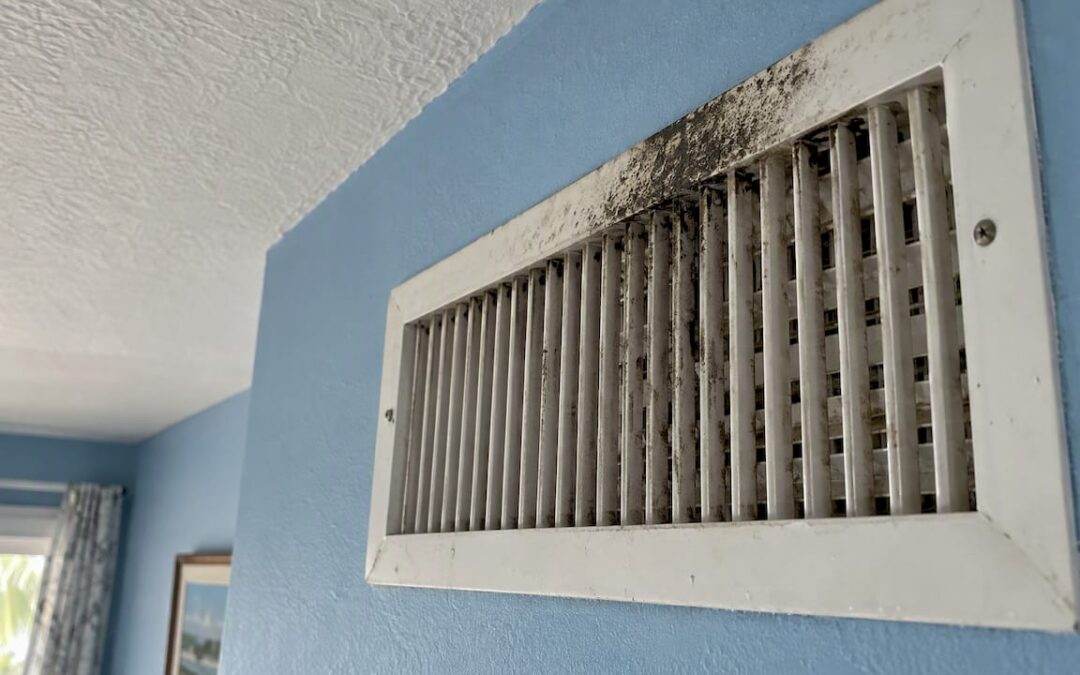
Mold around air vents is almost always a moisture problem, not a dirty-vent problem. In a Florida home, it usually means cold air from your AC is meeting warm, humid air at the register, and the water that forms is feeding dust and spores. You can wipe the surface, but if the moisture source stays, the mold comes back. This guide shows how to tell mold from dust, what you can safely clean, what to leave alone, and when the growth points to a problem inside your system.
Key takeaways
- Mold around vents needs moisture. Condensation on cold metal, a clogged drain pan, leaky or uninsulated ducts, and high indoor humidity are the usual sources.
- Black or dark spots are not always mold. They can be dust, rust or insulation fibers, and only a qualified person can confirm what it is.
- Light surface mold on a hard grille can be cleaned with soap and water, with gloves, goggles and a respirator. Mold inside insulated ducting generally means replacement, not cleaning.
- Painting, caulking or spraying over mold does not fix it. Fix the water problem first, then clean.
- If you see mold on more than one vent, smell mustiness when the AC runs, or anyone in the home has asthma or a weakened immune system, have the system inspected.
Table of Contents
- Why mold grows around air vents
- The most common root causes
- Mold or dust? How to tell the difference
- Is mold around air vents harmful?
- What you can clean yourself
- What you should not clean yourself
- When mold at a vent points to a problem inside the system
- How to stop mold from coming back
- Our perspective
- Get the cause found, not just the stain cleaned
- FAQ
- Sources
Why mold grows around air vents
Mold needs three things: moisture, a surface and something organic to eat. A supply vent in a humid house can provide all three. Cold air moves through a metal register while warm, moist air sits against the other side or the ceiling around it. Water condenses, dust settles into it, and spores that are already in the air have a place to grow.
The CDC explains that mold can travel into a home through open doors, windows, vents, and heating and air conditioning systems, and then grows wherever it finds moisture, such as leaks or flooding. The EPA adds that condensation can form when warm, humid air touches a cold surface such as an uninsulated AC duct.
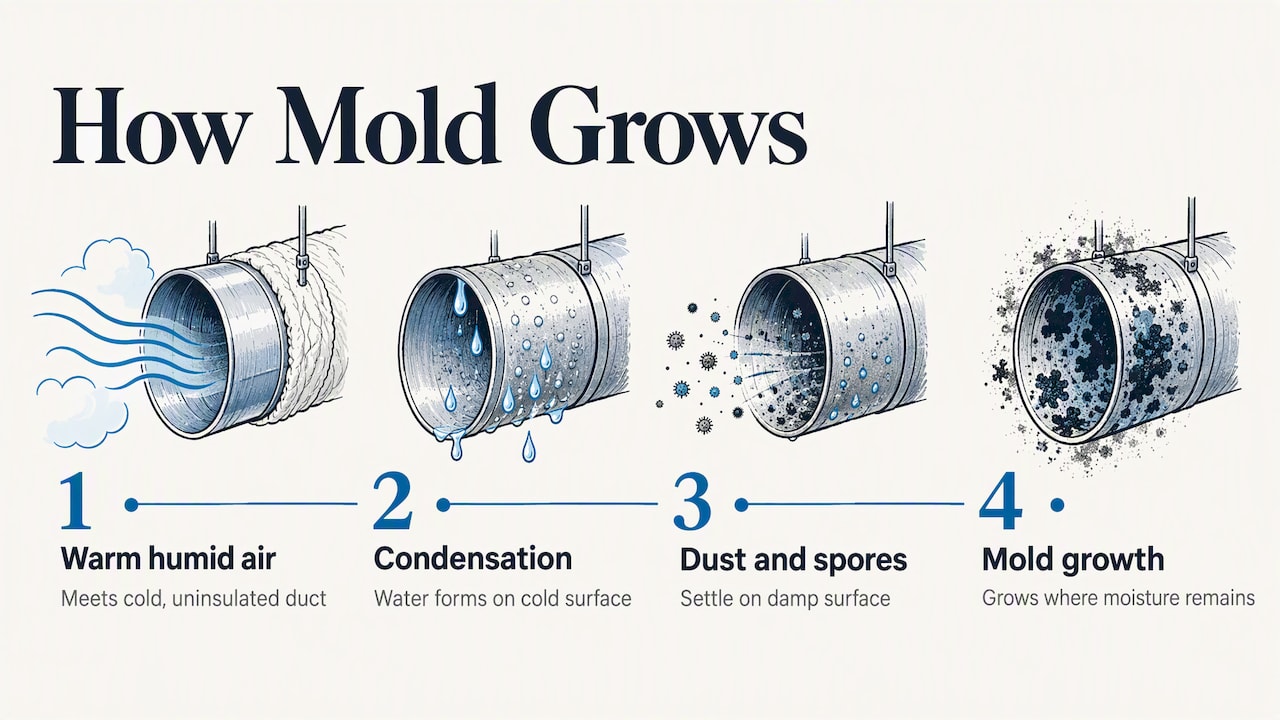
In Sarasota and Manatee Counties, that setup is common. Outdoor humidity is high for much of the year, attics are hot and damp, and the AC runs almost constantly. A small gap in duct insulation or a slightly undersized drain line can be enough to make a register sweat.
The most common root causes
Condensation on the register or duct
This is the leading cause. If the duct feeding the vent runs through a hot attic and its insulation is torn, wet, compressed or missing, the cold metal sweats. The drip lands on the grille, the drywall and the paint around it. You may see dark rings or a fuzzy film that follows the shape of the vent.
A cooling system that is not removing moisture
An air conditioner cools and dries the air. When it does not dry well, indoor humidity climbs. The EPA notes that an oversized air conditioner can cycle on and off frequently, which results in poor moisture removal, especially in high-humidity areas. The unit hits the thermostat setting quickly, shuts off, and leaves the air damp.
This is one reason we size installations to the home and to Florida humidity instead of simply matching the old unit. If you are replacing a system that has had repeat moisture problems, ask for a written load calculation and an explanation of how the new system will handle humidity. Our AC installation service starts with that conversation.
A clogged drain pan or condensate line
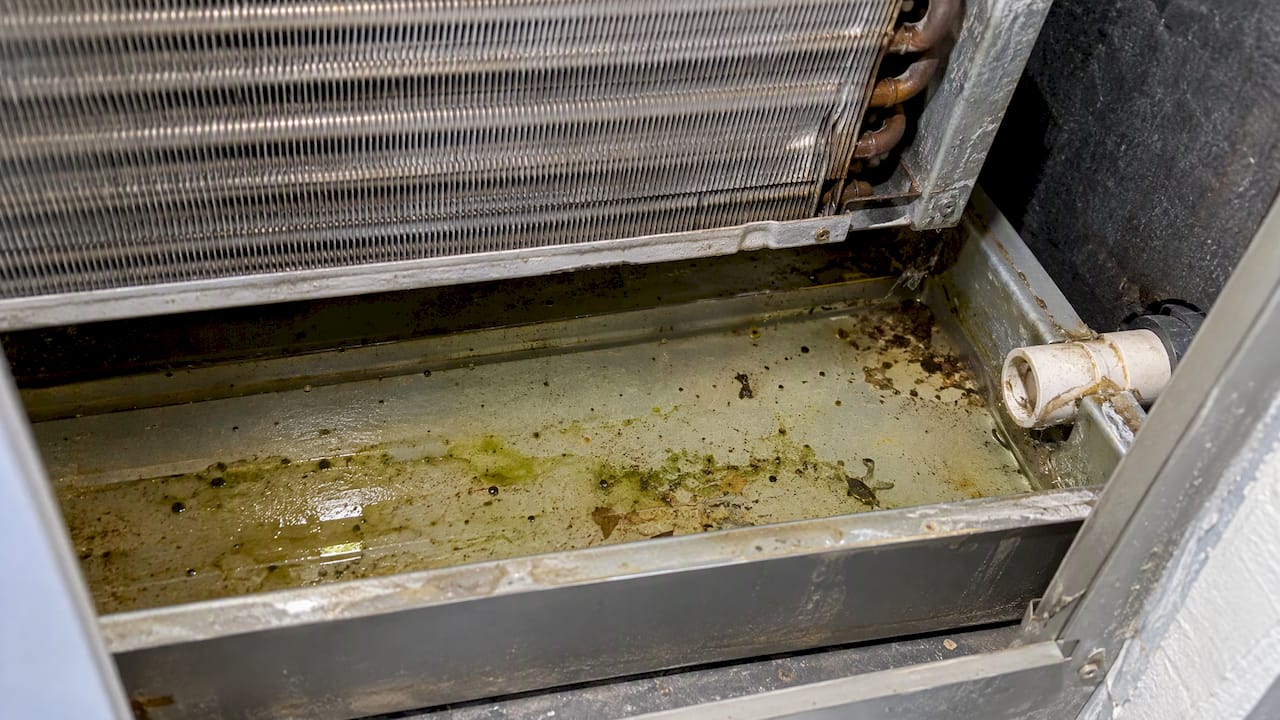
The coil pulls water out of the air, and that water must leave through the drain. The EPA’s guidance on moisture control says drain pans should slope toward the drain and drains should flow freely. When the line clogs with algae or debris, the pan overflows or stays wet, humidity rises inside the air handler and the ducts, and mold can follow.
Leaky ducts
Duct leaks in an attic pull in hot, wet air and let cold air escape. The result is condensation where the two meet. Loose connections near the register boot are a frequent culprit, which is why the mold often shows up right where the vent meets the ceiling.
High humidity in the house
The CDC recommends keeping indoor humidity no higher than 50%. Showers without exhaust fans, drying laundry indoors, a thermostat left on “on” instead of “auto,” and an AC that is set too high all push the number up. A cheap hygrometer will tell you where you stand.
Water damage you have not found yet
A roof leak, a plumbing leak above the ceiling or a past flood can wet the area around a vent. If the mold sits on a ceiling in a spot that does not match the airflow, look for a leak before blaming the AC. The CDC advises drying a flooded home fully and quickly, within 24 to 48 hours, to prevent mold growth.
The same principle applies to any enclosed space. If you want to see how ventilation and condensation interact outside a house, this piece on preventing condensation through ventilation covers it for a garden room.
Mold or dust? How to tell the difference
Dust tends to be gray, soft and wipes away cleanly, usually collecting on the edges of the louvers where air blows past. Mold tends to be spotty or fuzzy, may be black, green, white or brown, often smells musty, and smears or stains when you wipe it. It also tends to appear on a damp area, like a ceiling ring around the register.
Here is a quick comparison:
| Sign | More likely dust | More likely mold |
|---|---|---|
| Texture | Soft, lint-like | Fuzzy, slimy or stain-like |
| Wipes off | Easily, leaves no mark | Leaves a stain or smears |
| Location | Louver edges, airflow path | Rings and spots on surrounding drywall or paint |
| Smell | None or dusty | Musty or earthy |
| Surface | Dry | Damp, or recently damp |
Black material can also be something else. UL Solutions says black particles around a vent may be rust, insulation or mold, and laboratory analysis may be needed if a visual check is inconclusive. The EPA states that what looks like mold may not be, and that only an expert can determine whether it is.
You do not always need a lab test. The CDC does not recommend routine mold testing in homes, because there are no federal standards for acceptable mold levels and the type of mold does not change the cleanup response. Treat visible growth as mold, fix the moisture and clean it. Testing is more useful when the source is unclear or someone is sick and you need answers.
Is mold around air vents harmful?
It can be. According to the CDC, mold exposure can cause a stuffy nose, sore throat, coughing, wheezing and skin rashes. People with asthma, mold allergies or weakened immune systems can have stronger reactions. A vent is a special case because the system moves air through the whole house, so spores near a register can spread.
The color does not tell you how dangerous it is. Many people worry about “black mold,” but you cannot identify the species by looking, and the cleanup steps are the same. If anyone in the household has breathing problems or a compromised immune system, talk to their doctor and have a professional handle the cleanup. The CDC says people with weakened immune systems should not enter moldy buildings or help clean up mold.
What you can clean yourself
You can handle a small amount of surface mold on a hard, non-porous grille or on the wall around it. Do this only if the growth is limited and the cause is clear.
- Turn the system off. Shut the AC off at the thermostat so it does not blow spores around while you work. If you can, switch off the air handler at the breaker.
- Protect yourself. The CDC recommends rubber boots, gloves and goggles, and the CDC’s cleanup guide recommends an N-95 respirator. Open windows and doors where you can.
- Remove the grille. Unscrew it and take it outside or to a utility sink. Look into the duct behind it with a flashlight. If the duct interior is also moldy, stop.
- Clean hard surfaces. The CDC says soap and water work, or a bleach solution of no more than 1 cup per gallon of water. Never mix bleach with ammonia or other cleaners.
- Dry everything. Dry the grille and surrounding surface completely before you put it back.
- Find the cause. If you do not fix the moisture, it will return.
The same CDC guide warns that painting or caulking over mold will not stop it from coming back. Fix the water problem completely and clean up the mold first.
What you should not clean yourself
Some situations are not a weekend job.
- Mold inside insulated or flex ducts. The EPA says that if mold is found in insulated air ducts, the material cannot be cleaned effectively and should be removed and replaced.
- Mold on the coil, drain pan or inside the air handler. These parts need access and the right tools.
- Widespread growth. Substantial visible mold inside hard-surface ducts or on other HVAC components is, per the EPA, a reason to consider duct cleaning.
- Spraying anything into the ducts. Household sprays and fogging products are not a substitute for fixing moisture and removing contamination.
- A household member with asthma or a weakened immune system. Have someone else handle it.
The EPA’s mold guidance also says an HVAC system found to be contaminated with mold should be turned off and not used until it has been remediated, and that professional judgment is required. In July or August in Florida, that is a hard instruction to follow, so it helps to call early.
A note on licensing in Florida
Mold assessment and remediation are regulated trades in Florida. The Department of Business and Professional Regulation licenses mold-related services under Chapter 468, Part XVI of the Florida Statutes. If your problem is widespread mold in the home itself, check that the mold company you hire holds the right state license. We are an HVAC company: we find and fix the system problem that is feeding the mold, and we can work alongside a licensed mold professional when a job calls for one.
When mold at a vent points to a problem inside the system
Surface mold on a grille can be a one-off. These signs mean the moisture source is likely inside the HVAC system:
- Mold on several vents in different rooms.
- A musty smell that appears when the AC starts.
- Water stains, drips or dampness near registers, or sweating ducts in the attic.
- Water around the air handler, or a drain line that backs up.
- Rooms that stay clammy even though the AC runs.
- Mold that returns within weeks of cleaning.
A proper diagnosis looks at the whole path the moisture takes: the coil, the drain pan and line, the duct insulation and seals, the register boots, the airflow and the humidity in the house. That is how we work. We diagnose first and give you a written estimate before any work, and we do not start with a sales pitch. If the answer is a clogged drain line, you should pay for a drain line, not a new system.
If the inspection finds contaminated, insulated ductwork, expect a recommendation to replace it. Our ductwork service covers repair and replacement, and our air duct cleaning applies where hard-surface ducts and components can be cleaned. If the system is leaking, wet or failing, our AC repair team can usually come the same day.
How to stop mold from coming back
The best prevention is moisture control. The EPA identifies it as the most effective way to prevent biological growth in air ducts. For a Florida home, that comes down to a short list.
- Keep indoor humidity at or below 50%. Use a hygrometer. Run bathroom and kitchen exhaust fans, and make sure they vent outdoors.
- Set the thermostat fan to “auto.” Leaving it on “on” can blow moisture off a wet coil back into the house.
- Change filters on schedule. The EPA recommends regular filter changes with high-efficiency filters and making sure air does not bypass the filter.
- Have the coil and drain pan checked. The EPA lists cleaning of cooling coils and drain pans among routine professional maintenance tasks.
- Seal and insulate ducts. Gaps and torn insulation in the attic are a frequent source of condensation.
- Fix leaks quickly. Roof, plumbing and window leaks near vents feed mold.
- Have the equipment assessed. The EPA’s indoor air guidelines say HVAC equipment should be assessed for correct sizing and proper drainage.
Most of that is what a maintenance visit covers. Our preventative AC maintenance is offered as an annual or semi-annual program, and in a climate where the system works nearly all year, many homeowners prefer the twice-a-year schedule. Ask us for current program details.
Our perspective
We see mold around vents in Sarasota, Bradenton, Lakewood Ranch, Venice and on Longboat Key, and the pattern is consistent. People clean the vent, repaint the ceiling and think they are done. Six weeks later the ring is back, because nobody looked at why the metal was wet.
There is also a lot of fear in this space. Some companies lead with a scary photo and a big quote for a full system replacement or whole-house treatment. We think you should get the diagnosis first. Sometimes the fix is a drain line, a sealed boot or fresh insulation. Sometimes the ducts really do need to come out. Either way, you should get it in writing, with the reasons, and with a one-year labor warranty on our work.
Our advice: do not ignore it, do not panic, and do not paint over it. Turn the system off if the growth is heavy, clean only what is small and hard-surfaced, and call someone who will look at the whole system.
— Zach
Get the cause found, not just the stain cleaned
If mold keeps showing up around your vents, we will inspect the coil, drain, ducts and airflow, tell you what is feeding the moisture, and give you a written estimate before any work begins. We offer same-day and emergency service across Sarasota and Manatee Counties, and military and veteran discounts. Start with our AC repair page, or call for urgent problems through our emergency AC repair service.
FAQ
What is the black stuff around my air vents?
It can be mold, dust, rust or insulation fibers. Dust wipes away easily and sits where air blows past. Mold stains, smells musty and appears where things are damp. If you cannot tell, have someone inspect it, because a visual check is not always conclusive.
Is mold in air vents dangerous?
It can irritate the nose, throat and lungs and cause coughing, wheezing or rashes, and the effects are stronger for people with asthma, allergies or weak immune systems. You cannot judge danger by color. Fix the moisture and remove the mold promptly, and ask a doctor about symptoms.
Can I clean mold off an AC vent myself?
Yes, for small amounts on a hard grille or wall. Turn the AC off, wear gloves, goggles and an N-95 respirator, and clean with soap and water or a diluted bleach solution. Do not attempt it if the mold is inside the ducts, on insulation, or if someone in the home has a weakened immune system.
How do I stop mold from growing around air vents?
Control moisture. Keep indoor humidity at or below 50%, use exhaust fans, fix leaks, change filters, seal and insulate ducts, and keep the drain line and pan clear through regular maintenance. Cleaning alone will not hold if the cause stays.
Do I need to replace my ducts if there is mold?
Not always. Hard-surface ducts with limited growth can sometimes be cleaned after the moisture source is fixed. Insulated or flex ducting with mold generally needs to be removed and replaced, according to the EPA. An inspection will tell you which applies.
Sources
- CDC: Mold
- EPA: Mold Course, Chapter 2
- EPA: Should You Have the Air Ducts in Your Home Cleaned? (PDF)
- EPA: Should I have the air ducts in my home cleaned?
- UL Solutions: Black Particles and the HVAC System
- CDC: Homeowner’s and Renter’s Guide to Mold Cleanup
- CDC: Invasive Mold Infections in Immunocompromised People
- EPA: Energy Savings Plus Health, IAQ Guidelines
- Florida DBPR: Mold-Related Services FAQs
- Ventilation and condensation prevention