
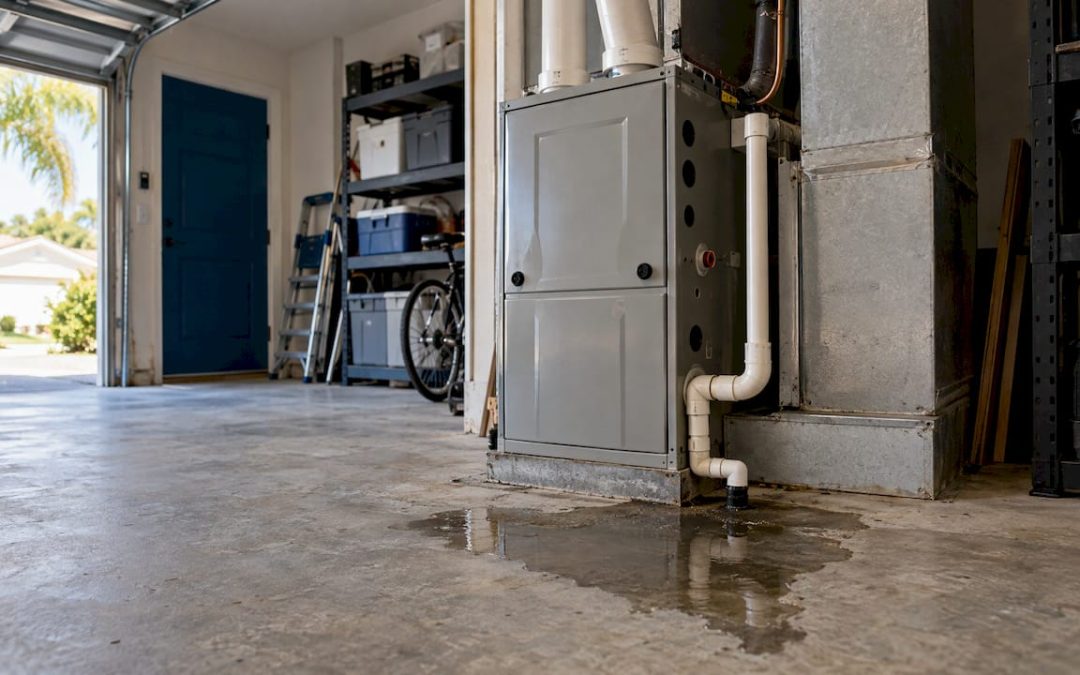
Water around a furnace is not normal, and it is rarely the furnace itself that is the problem. In most homes it comes from the condensate drain, a condensate pump, the air conditioner’s coil and drain pan, or a humidifier. The first step is to turn the system off at the thermostat, soak up the water and note when it showed up. If the cause is not obvious, call a technician before the damp turns into rust, mold or a tripped safety shutdown. In Sarasota and Manatee Counties, we diagnose the source first and write up what we find before any work starts.
Key Takeaways
- Furnace manufacturers say that water pooling around a furnace is not normal, even though high-efficiency furnaces do make condensation.
- The usual sources are a clogged condensate drain, a frozen line, a failed condensate pump, a leaking humidifier or, when the AC is running, the evaporator coil’s drain pan.
- Turn the system off at the thermostat first. Shut off power at the breaker if water is near electrical parts or the leak is large.
- Leave the house at once and call for help if you smell gas or a carbon monoxide alarm sounds.
- A repeat leak means the cause was not fixed. A full diagnosis finds it, and regular maintenance keeps it from coming back.
Table of Contents
- Why a Furnace Produces Water at All
- Is It Your Furnace, Your AC or Your Humidifier?
- The Most Common Causes
- What to Do Right Away
- Can a Furnace Be Ruined by Water?
- Condensate Pump Replacement: Why It Is a Job for a Technician
- Why Repeat Leaks Happen
- How to Keep Water Away From Your Furnace
- When to Call a Professional
- Get Water Around Your Furnace Looked At
- FAQ
- Sources
Why a Furnace Produces Water at All
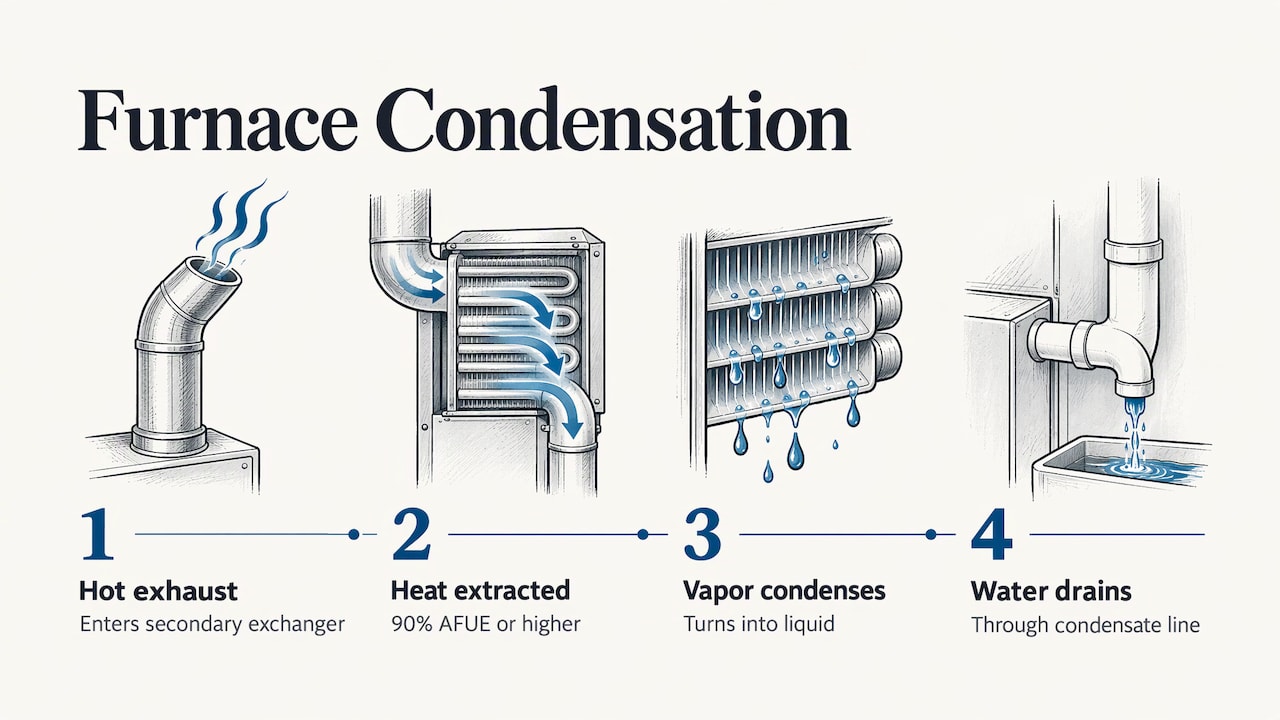
A standard gas furnace sends hot exhaust up a metal flue. A high-efficiency furnace, rated 90% AFUE or higher, pulls so much heat out of the exhaust that the water vapor turns to liquid. Trane explains that this happens in a secondary heat exchanger, and the liquid drains away through a condensate line.
The amount is real. Carrier’s guide says a 60,000 BTU/h furnace running at full input burns about 0.6 therms of natural gas an hour. That combustion can produce roughly 0.7 gallons of water vapor per hour before any of it is drained off. A condensing furnace is built to carry that water out of the house. When the path is blocked, the water has nowhere to go but the floor.
That is why a small puddle by a high-efficiency furnace is a drainage problem, not a sign the furnace is “sweating.”
Is It Your Furnace, Your AC or Your Humidifier?
Many Florida homes have the furnace, the air handler and the AC’s indoor coil sitting in one closet or attic. Water in that space could come from any of them. Two questions narrow it down fast.
When does the water appear?
- Only when the heat is on: think condensate line, condensate pump, humidifier or filter. Trane lists these as the usual heating-season sources.
- Only when the AC is on: think the evaporator coil’s drain pan and its drain line. The same Trane page says water during cooling comes from there.
- During a cold snap: think a frozen condensate line. Bryant’s diagnostic guide ties water appearing in freezing weather to a frozen line.
- All the time: more than one cause may be involved, or a slow clog is getting worse.
Florida adds a twist. You may run the AC ten months a year and the heat for a few weeks. A drain line that has been silently clogging all summer often shows itself the first cool morning, or the first time the system switches modes.
What type of furnace do you have?
Look at the exhaust pipe. Trane notes that metal exhaust pipe means a standard furnace, while white PVC pipe, paired with a PVC intake pipe, means a condensing furnace. If you have PVC pipes and water on the floor, the condensate system is the first suspect. If you have a metal flue and water, the cause is more likely a venting problem, and that needs a technician.
The Most Common Causes
A clogged condensate drain
The condensate line carries water from the furnace to a floor drain, a pump or the outdoors. Over time, dirt, slime and debris can build up in it. Bryant lists a clogged drain as one of the common culprits, and water around a high-efficiency furnace is the classic sign.
In Florida’s humidity, growth inside drain lines is a year-round issue. Trane says mold, mildew, dust and even spider webs can block the line over time.
Signs to notice:
- Water pooling near the base of the furnace
- Dampness or a musty smell in the closet or garage
- Gurgling or hissing sounds, which Carrier lists among the signs of a leaking furnace
- The furnace shutting off or blowing cold air, because a safety switch can trip when the line backs up
A failed condensate pump
When the furnace sits below the level of the drain, a small pump lifts the water out. If the pump fails, the reservoir fills and overflows. Pentair’s manual for its condensate pumps says any pump installed where water could do damage should have a failure alarm, a water sensor or a safety shutoff switch tied to the thermostat. That switch is the reason your system may simply stop when the pump has trouble.
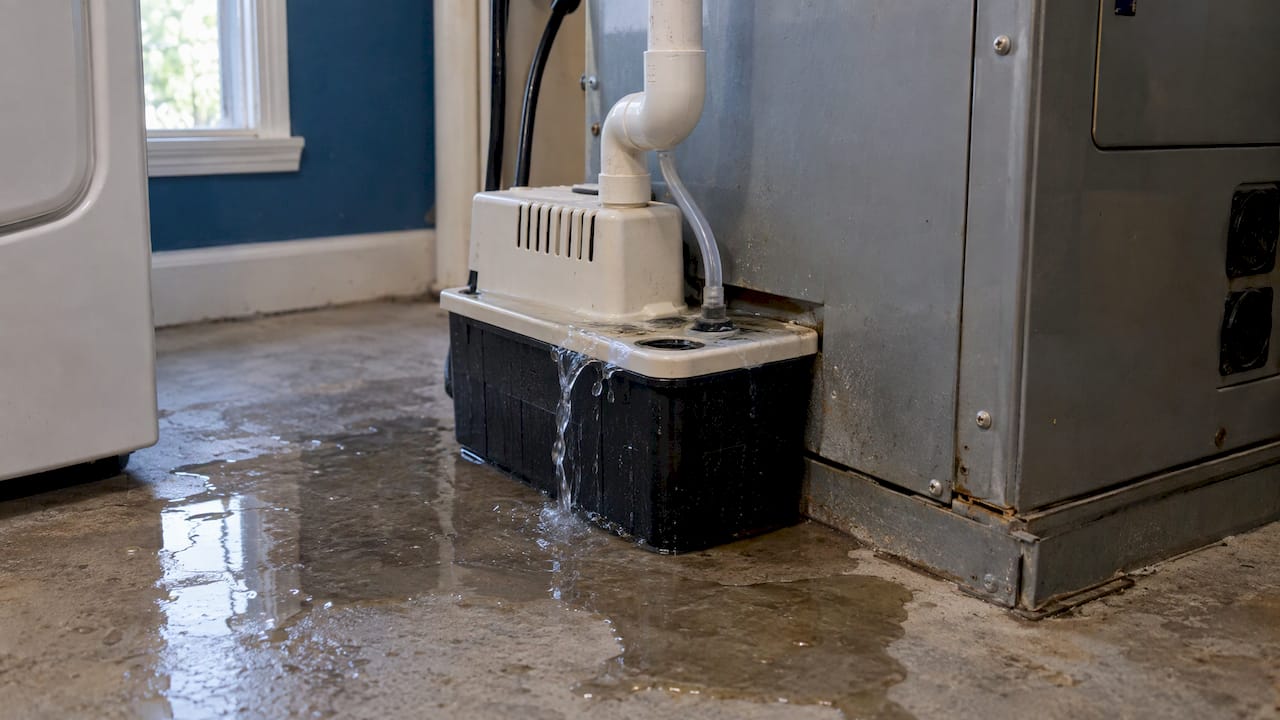
If the system keeps shutting down for the same reason, the pump, a blockage in the line or an electrical fault is behind it. All three call for a technician.
A leaking humidifier
A whole-house humidifier mounted on the furnace can leak from a clogged pad, a cracked drain line or loose connections. Trane includes it on its list of heating-season causes. Look for moisture around the humidifier and its tubing. In most of Florida, whole-house humidifiers are uncommon, so check whether one was added to your system before suspecting it.
A dirty air filter
A clogged filter restricts airflow. Trane says that can lead to frozen coils and overflow, and it recommends changing the filter every 1 to 3 months. When a coil freezes and then thaws, the extra water can overwhelm the drain pan.
A cracked or corroded drain pan
If the water shows up while the AC is running, the pan under the coil may be cracked or rusted through. The same Trane page names a damaged drain pan and a clogged condensate line as the top causes of AC water leaks. A pan is not a fix you can patch for long, and a leak there can reach ceilings and floors quickly in an attic installation.
What to Do Right Away
The steps below follow the guidance Bryant gives homeowners. They keep you safe and limit the damage while you wait for a technician.
- Turn the system off at the thermostat. If water is reaching electrical parts, or the leak is large, also shut off the furnace at its switch or the breaker. Never touch electrical components while standing in water.
- Soak up the standing water. Towels and a wet/dry vacuum keep it from spreading to drywall, flooring or insulation.
- Check the air filter. If it is packed with dust, replace it.
- Look for obvious problems. A kinked or visibly blocked accessible condensate line, or moisture around a humidifier, is worth noting. Do not use an open flame near a furnace.
- Write down what you saw. When did the water appear, was the heat or AC on, was the system cycling off? Those details speed up the diagnosis.
- Call a technician if the filter is clean and the drain looks clear, or if the water comes back.
Two situations skip all of that. If you smell gas or a carbon monoxide alarm goes off, leave the home immediately and call your gas utility or 911 from outside. And if water or corrosion appears inside the furnace itself, Carrier says that points to a possible heat exchanger or combustion issue and calls for a qualified HVAC professional right away.
Can a Furnace Be Ruined by Water?
A furnace that gets wet is not automatically ruined, but leaving it running with water around it is a bad idea. Carrier warns that unchecked moisture can lead to mold and mildew growth that threatens the home, and the water can also cause rust and safety shutdowns. In Florida, where indoor humidity is already high, a damp closet is an ideal spot for mold. If you see growth or smell mustiness, read our guide to mold in your HVAC system and mold around air vents.
The longer water sits, the more it costs. A clogged drain cleared the day you notice it is a small repair. The same leak left for weeks can mean a replaced pan, damaged flooring and a furnace that shuts down on its own.
Condensate Pump Replacement: Why It Is a Job for a Technician
People searching for pump replacement often find step-by-step guides. The steps look short, but the details are where it goes wrong. Beckett, a pump manufacturer, says the pump must be sized to the application, sit below the drain pan and be installed level so the float switches work. The manufacturer also cautions that every application differs, that a technically qualified HVAC professional should be consulted to avoid electrical shock, fire, equipment failure or property damage, and that installation must meet national and local electrical and plumbing codes.
There is also the safety switch. It has to be wired into the thermostat circuit so the system stops before the reservoir overflows. A pump that runs but is wired wrong can still flood the closet. A technician sizes the pump, wires the switch, tests the float and checks the whole drain path, so you are not replacing a pump while the real clog sits farther down the line.
Why Repeat Leaks Happen
If a drain gets cleared and the water returns in a few weeks, something upstream is still wrong. Common reasons:
- A dirty coil or filter is sending extra water into the system
- The drain line was installed with too little slope or a poor trap
- A pan is cracked in a place that is hard to see
- A pump is aging and the safety switch is tripping again and again
- The duct system or the unit’s installation is adding moisture
These are diagnosis problems, not cleaning problems. A technician who only clears the line and leaves treats the symptom. One who traces the water back to its source ends the leak.
How to Keep Water Away From Your Furnace
Prevention is mostly routine:
- Change the air filter every 1 to 3 months, as Trane recommends.
- Have the condensate drain flushed and checked before the seasons change.
- Have the drain pan inspected for cracks and corrosion, and replaced if damaged.
- Test the condensate pump and its safety switch so you know it shuts the system down when it should.
- Protect drain lines from freezing in cold weather with insulation, as maintenance providers advise.
For Florida homes this pairs naturally with cooling-season care, since the same drain system serves both modes. Our preventative AC maintenance program covers annual and semi-annual visits, and our article on keeping your system running efficiently year-round explains what a visit looks for. If your heat is also acting up, these guides cover heat not working and a heater that won’t turn on. If bills are climbing too, see high heating bills.
When to Call a Professional
Call right away when:
- Water is reaching electrical components or the floor around the unit is soaked
- The system keeps shutting down or blowing cold air
- The filter is clean and the drain looks clear, but water still shows up
- You see rust, corrosion or water inside the furnace cabinet
- The leak returns after you cleaned up
- You have a metal-flue furnace with water around it
- You smell gas or a CO alarm sounds (leave first, then call)
If the leak happens at night, on a weekend or in the middle of a Florida heat wave with the AC involved, our emergency AC repair line is open 24/7 for urgent calls.
Our View: Find the Water’s Source Before Anything Else
We work on systems in Sarasota, Bradenton, Lakewood Ranch, Venice and Longboat Key, and we start every job the same way: a thorough diagnostic before any sales pitch. Water in a closet is a good example of why. The same puddle can come from a drain, a pan, a pump or a coil, and each has a different fix.
In Florida’s humidity, drain systems work hard. A homeowner who treats a puddle as a one-off often finds it again. We would rather trace it, give you a clear written estimate and fix what is actually causing it, with a one-year labor warranty on our work.
Thanks to our military and veteran discounts, and our veteran ownership, we treat this as a service to neighbors, not a transaction.
Zach
Get Water Around Your Furnace Looked At
If you are seeing water around your furnace or air handler in Sarasota or Manatee County, our technicians can diagnose where it comes from and give you a transparent written estimate before work begins. We handle same-day repairs and 24/7 urgent calls, and military and veterans receive discounts on services. Start with our AC repair page, or reach us through AC Heroes.
FAQ
Is it normal to have water around a furnace?
No. A high-efficiency furnace makes condensation, but it is meant to drain away through a line. Bryant says pooling water is not normal and should be addressed promptly to prevent water damage and equipment problems.
Should I turn my furnace or AC off if it is leaking water?
Yes, turn it off at the thermostat when there is significant pooling, water near electrical parts or repeated shutdowns. Running a system with a draining problem can damage it, as Trane notes for AC units. Shut off power at the breaker if the leak is large, then call a technician.
What are the symptoms of a clogged condensate drain?
Expect water near the base of the furnace, a damp or musty smell, gurgling sounds, and sometimes a shutdown or cold air because a safety switch trips. The pattern often shows when the system changes between cooling and heating.
Why is my furnace leaking water when the AC is on?
When the AC runs, the indoor coil makes the water, and it should leave through the drain pan and line. A clogged line, a cracked pan or a frozen coil from a dirty filter can all send it onto the floor. A technician can tell which one it is.
Does a condensate pump need to be replaced when it fails?
Usually yes, but the pump is often only part of the problem. It has to be sized correctly, installed level and wired to a safety switch, and the drain path needs checking at the same time. Manufacturers recommend a qualified HVAC professional for the job.
Sources
- Furnace Leaking Water? Find Out Why and What to Do, Trane
- AC Leaking Water? Find Out Why and What to Do, Trane
- Why Is My Furnace Leaking Water? Causes and Fixes, Bryant
- Furnace Leaking Water? Causes, Signs, and Repair Steps, Carrier
- 5 Easy Steps for Replacing Beckett Condensate Pump, Beckett Corporation
- Hydromatic HCU Series Condensate Pumps Manual, Pentair